Cut ML Training Costs 2026: Insider Tips for Cloud Spend Reduction

Optimizing machine learning training costs in 2026 involves a multi-faceted approach, integrating advanced cloud resource management, strategic model development, and leveraging emerging technologies to achieve substantial annual savings.
In the rapidly evolving landscape of artificial intelligence, managing the expenses associated with machine learning (ML) model training has become a critical challenge. As we look towards 2026, organizations are increasingly seeking innovative strategies to reduce their cloud spend without compromising performance or innovation. This article delves into insider tips for optimizing machine learning training costs in 2026, offering actionable insights to help you achieve significant savings, potentially cutting your annual cloud expenditure by 20% or more.
Understanding the ML Cost Landscape in 2026
The financial demands of machine learning training are projected to continue their upward trajectory into 2026, driven by larger datasets, more complex models, and the increasing computational power required. This section explores the primary cost drivers and sets the stage for understanding where optimization efforts will yield the most significant returns.
Traditionally, GPU hours, data storage, and data transfer have been the major contributors to cloud bills for ML workloads. However, in 2026, we see newer factors emerging, such as specialized AI accelerators, advanced data orchestration services, and the increasing reliance on serverless ML platforms, all of which come with their own pricing models and optimization challenges. Understanding these nuances is the first step towards effective cost management.
Key Cost Drivers in Modern ML Workflows
Navigating the financial complexities of machine learning demands a clear understanding of its primary cost drivers. These elements often represent the largest portions of an ML budget, and identifying them is crucial for strategic cost reduction efforts.
- Compute Resources: High-performance GPUs and TPUs, essential for deep learning, constitute a significant portion of training costs due to their specialized nature and high demand.
- Data Storage and Egress: Storing vast datasets and transferring them between different cloud services or regions can quickly accumulate substantial costs, especially with large-scale projects.
- Managed ML Services: While offering convenience, managed platforms for data labeling, model deployment, and MLOps can introduce hidden costs if not carefully monitored and optimized.
- Software Licenses and Frameworks: Specialized software, proprietary tools, and even commercial versions of open-source frameworks can add to the overall expenditure, particularly in enterprise environments.
In conclusion, the 2026 ML cost landscape is multifaceted, requiring a granular view of expenditures beyond just raw compute. By identifying and understanding these core drivers, organizations can begin to formulate targeted strategies for significant savings.
Leveraging Cloud-Native Optimization Techniques
Cloud providers offer an array of features specifically designed to help users manage and reduce their spending. In 2026, fully harnessing these cloud-native optimization techniques is paramount for achieving substantial cost reductions in ML training. This goes beyond simply choosing cheaper instances; it involves a deeper integration with the cloud ecosystem.
One of the most impactful strategies involves the intelligent use of spot instances or preemptible VMs. These offer significantly lower prices compared to on-demand instances, often at a discount of 70-90%. While they can be interrupted, modern ML frameworks and robust checkpointing strategies make them highly viable for many training workloads, especially those that are fault-tolerant or can be resumed easily.
Strategic Instance Selection and Management
Choosing the right compute instance for your ML workload is not a one-size-fits-all decision; it requires careful consideration of performance, cost, and availability. Strategic instance selection can dramatically impact your overall training expenses.
- Right-Sizing Instances: Avoid over-provisioning. Analyze your model’s computational needs and select instances with just enough CPU, RAM, and GPU resources to perform efficiently without waste.
- Spot Instances for Batch Training: Utilize spot or preemptible instances for non-critical, interruptible training jobs. Implement robust checkpointing to save progress and resume training if an instance is reclaimed.
- Reserved Instances for Stable Workloads: For long-running, predictable workloads, purchasing reserved instances can offer significant discounts over on-demand pricing, locking in lower rates for extended periods.
- Serverless ML Training: Explore serverless options where available for smaller, burstable training jobs. These services charge only for actual compute time, eliminating idle resource costs.
By meticulously matching instance types to workload requirements and actively managing their lifecycle, organizations can achieve considerable savings. This proactive approach ensures that resources are neither underutilized nor excessively expensive, providing a balanced cost-performance ratio for ML training.
Advanced Data Management for Cost Efficiency
Data is the fuel for machine learning, but its management can quickly become a significant cost center if not handled efficiently. In 2026, advanced data management strategies are crucial for minimizing storage, transfer, and processing expenses while ensuring data quality and accessibility for ML training.
Implementing intelligent data tiering is a prime example. Automatically moving infrequently accessed or older training data to cheaper archival storage classes can yield substantial savings. Furthermore, optimizing data formats and compression techniques can reduce storage footprints and accelerate data loading times, indirectly lowering compute costs.
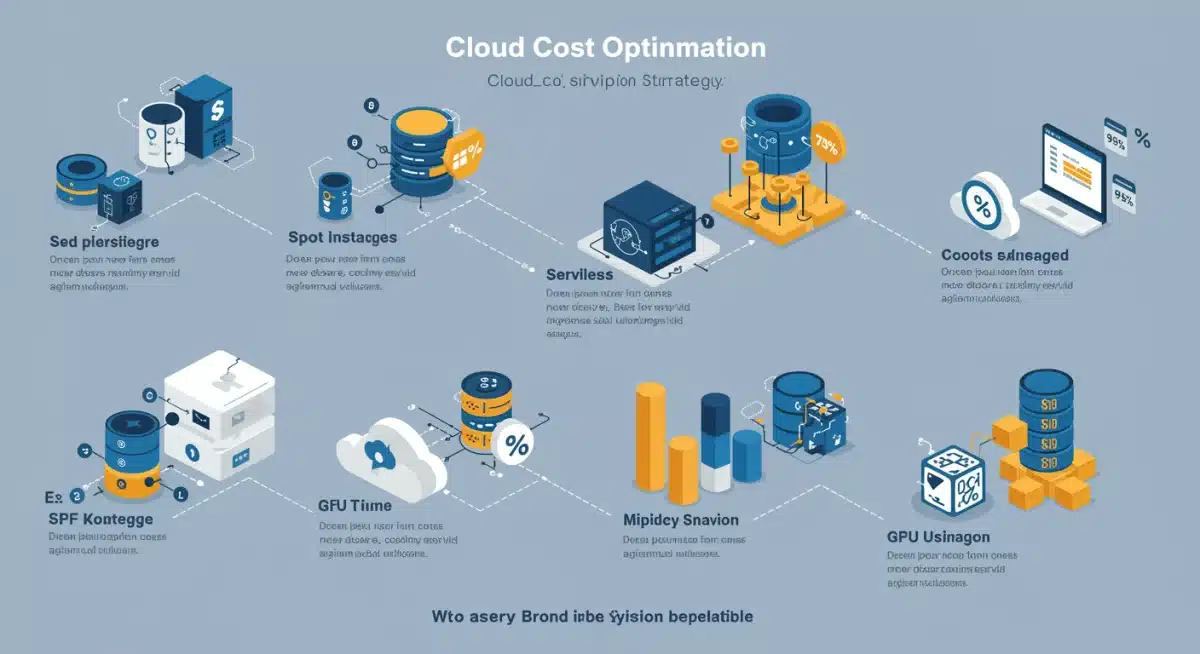
Optimizing Data Storage and Transfer
Efficient data handling is paramount in reducing the total cost of ownership for machine learning projects. Storage and data transfer often represent hidden costs that can accumulate rapidly.
- Intelligent Data Tiering: Implement policies to automatically move data between hot, cold, and archive storage tiers based on access frequency, ensuring cost-effective storage for different data lifecycles.
- Data Compression and Deduplication: Apply advanced compression algorithms and deduplication techniques to reduce the physical storage footprint of datasets, lowering both storage and transfer costs.
- Regional Data Locality: Store data in the same cloud region as your compute resources to minimize data transfer costs (egress fees) and reduce latency during training.
- Optimized Data Formats: Use efficient data formats like Parquet or ORC for tabular data, or specialized formats for image/video data, which are optimized for read performance and storage efficiency.
In summary, a proactive and intelligent approach to data storage and transfer is fundamental. By minimizing redundant data, leveraging cost-effective storage tiers, and ensuring data locality, organizations can significantly reduce one of the most persistent cost factors in ML training.
Model Optimization and Training Efficiency
Beyond infrastructure, the very design and training process of your machine learning models offer immense opportunities for cost reduction. In 2026, focusing on model optimization and training efficiency is key to unlocking significant savings, as faster and smaller models require less compute and energy.
Techniques such as model pruning, quantization, and knowledge distillation allow for the creation of smaller, more efficient models that perform comparably to their larger counterparts but with drastically reduced inference and training costs. Furthermore, adopting advanced training methodologies like transfer learning can minimize the need for extensive, costly training from scratch.
Techniques for Reduced Training Time and Resource Consumption
Reducing the computational resources and time required for model training directly translates into lower cloud costs. Several cutting-edge techniques are instrumental in achieving this efficiency.
- Gradient Accumulation: Simulate larger batch sizes without increasing memory consumption, allowing for more stable training with fewer actual updates and potentially faster convergence.
- Mixed-Precision Training: Utilize lower-precision data types (e.g., FP16 instead of FP32) for computations. This significantly reduces memory usage and speeds up training on compatible hardware, such as modern GPUs.
- Early Stopping: Monitor model performance on a validation set and stop training once performance plateaus or degrades, preventing overfitting and unnecessary compute cycles.
- Transfer Learning and Pre-trained Models: Leverage pre-trained models on large datasets and fine-tune them for specific tasks. This drastically reduces the need for extensive training from scratch, saving considerable time and resources.
By integrating these model optimization and training efficiency techniques, organizations can develop high-performing models using fewer resources, directly impacting the bottom line. This strategic approach ensures that every compute cycle is utilized effectively, leading to significant cost savings.
Automating MLOps for Sustained Savings
Manual processes in machine learning operations (MLOps) are not only prone to error but are also inherently inefficient and costly. In 2026, the automation of MLOps pipelines is no longer a luxury but a necessity for sustained cost reduction in ML training and deployment. Automation ensures consistency, reduces human error, and optimizes resource utilization.
Implementing CI/CD for ML (CI/CD4ML) allows for automated testing, integration, and deployment of models, ensuring that only validated and efficient models consume production resources. Automated resource scaling, driven by real-time workload metrics, prevents over-provisioning and idle compute charges.
Implementing Efficient MLOps Practices
Streamlined MLOps practices are pivotal for cost-effective and scalable machine learning initiatives. Automation across the ML lifecycle minimizes manual intervention, leading to greater efficiency and reduced operational expenses.
- Automated Resource Provisioning: Use infrastructure-as-code (IaC) tools to automatically provision and de-provision training environments, ensuring resources are only active when needed.
- Continuous Integration/Continuous Delivery (CI/CD) for ML: Automate the testing, building, and deployment of model code and data pipelines, reducing manual overhead and accelerating iteration cycles.
- Monitoring and Alerting: Implement robust monitoring for resource utilization and model performance. Set up alerts for anomalies or underutilized resources to prompt immediate optimization actions.
- Experiment Tracking and Management: Centralize metadata from ML experiments, including hyperparameter configurations, datasets, and model metrics, to avoid redundant experiments and efficiently reproduce results.
By embracing comprehensive MLOps automation, organizations can significantly reduce operational costs, accelerate model development, and ensure that ML resources are always utilized optimally. This translates into predictable costs and enhanced efficiency across the entire ML pipeline.
Strategic Cost Governance and Monitoring
Even with the most advanced optimization techniques, without robust cost governance and continuous monitoring, expenditures can quickly spiral out of control. In 2026, a proactive and systematic approach to tracking, analyzing, and forecasting ML training costs is essential for maintaining budgetary discipline and identifying new saving opportunities.
This includes setting up detailed billing alerts, implementing chargeback mechanisms for different teams or projects, and leveraging cloud provider cost management tools. Regular cost reviews, combined with performance metrics, allow for informed decisions on resource allocation and optimization strategies.
Tools and Practices for Effective Cost Oversight
Effective cost governance requires a combination of specialized tools and disciplined practices to maintain financial control over ML expenditures. Without these, even well-intentioned optimization efforts can fall short.
- Cloud Cost Management Platforms: Utilize native cloud provider tools (e.g., AWS Cost Explorer, Azure Cost Management, Google Cloud Billing) or third-party solutions to gain granular visibility into spending across all ML services.
- Detailed Tagging and Labeling: Implement a consistent tagging strategy for all cloud resources. This allows for accurate cost allocation to specific projects, teams, or models, facilitating chargebacks and accountability.
- Budget Alerts and Quotas: Set up automated alerts for when spending approaches predefined thresholds and enforce quotas on resource usage to prevent unexpected cost overruns.
- Regular Cost Reviews: Conduct periodic reviews of ML spending with relevant stakeholders. Analyze cost trends, identify anomalies, and discuss potential optimization strategies based on actual usage data.
By establishing a strong framework for cost governance and monitoring, organizations can ensure that their ML investments remain financially sound and sustainable. This continuous oversight is a critical component of achieving and maintaining significant cost reductions in the long term.
| Key Strategy | Brief Description |
|---|---|
| Cloud-Native Optimization | Utilize spot instances, right-size VMs, and leverage serverless ML for dynamic compute savings. |
| Advanced Data Management | Implement intelligent data tiering, compression, and regional locality to minimize storage and transfer costs. |
| Model & Training Efficiency | Employ mixed-precision training, early stopping, and transfer learning to reduce compute cycles. |
| Automated MLOps | Automate provisioning, CI/CD, and experiment tracking for operational efficiency and cost control. |
Frequently Asked Questions About ML Cost Optimization
In 2026, the primary cost drivers for ML training are high-performance compute resources like GPUs/TPUs, extensive data storage and egress fees, and the increasing complexity of managed ML services. Specialized AI accelerators and advanced data orchestration also contribute significantly to overall expenses.
Spot instances offer substantial discounts (70-90%) compared to on-demand pricing. By utilizing them for fault-tolerant or resumable training jobs and implementing robust checkpointing, organizations can significantly cut compute costs without losing progress, making them ideal for many ML workloads.
Efficient data management is crucial. Implementing intelligent data tiering, compression, and ensuring data locality (storing data near compute) minimizes storage fees and costly data transfer charges. Optimized data formats also reduce storage footprint and accelerate processing, thereby lowering overall costs.
Absolutely. Techniques like mixed-precision training, early stopping, and transfer learning drastically reduce the compute time and resources required for model training. By making models more efficient and training processes faster, these methods directly translate into substantial savings on cloud infrastructure.
MLOps automation ensures consistency, reduces manual errors, and optimizes resource utilization. Automated provisioning, CI/CD pipelines, and experiment tracking prevent over-provisioning and idle resources, leading to predictable costs and enhanced operational efficiency across the entire machine learning lifecycle.
Conclusion
The journey to effectively optimizing machine learning training costs in 2026 is multifaceted, demanding a blend of technical acumen, strategic planning, and continuous vigilance. By adopting the insider tips discussed—from leveraging cloud-native optimization and advanced data management to implementing model efficiency techniques, automating MLOps, and establishing robust cost governance—organizations can realistically target and achieve a 20% or greater annual reduction in their cloud spend. The future of AI success hinges not just on innovative models, but on the sustainable, cost-effective infrastructure that powers them, ensuring that innovation remains accessible and financially viable for all.