Transfer Learning for Small Datasets: 3-Month Guide to 85% Performance
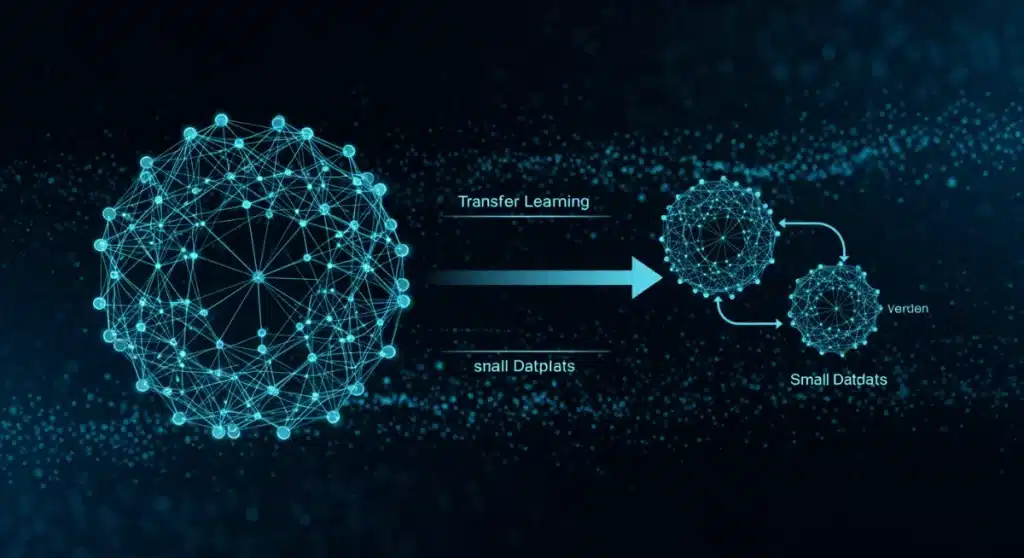
Implementing transfer learning for small datasets can achieve 85% performance with limited resources by leveraging pre-trained models and strategic fine-tuning within a focused 3-month timeframe.
In the rapidly evolving landscape of artificial intelligence, achieving high performance with limited data and resources is a paramount challenge. Our comprehensive 3-month guide to implementing transfer learning for small datasets: achieving 85% performance with limited resources in 2025 offers a strategic roadmap for practitioners and researchers alike to overcome these hurdles, leveraging the power of pre-trained models to accelerate development and enhance model accuracy.
Understanding Transfer Learning and Its Advantages
Transfer learning has emerged as a cornerstone technique in machine learning, particularly deep learning, for addressing scenarios where data availability is scarce. Instead of training a model from scratch, which demands vast amounts of labeled data and computational power, transfer learning involves taking a pre-trained model—one that has already learned to perform a similar task on a large dataset—and adapting it to a new, often smaller, dataset.
This approach offers significant advantages, including reduced training time, lower computational costs, and, most critically, improved performance on tasks with limited data. The underlying principle is that features learned in one domain can often be generalized and applied effectively to another, related domain. For instance, a model trained to recognize objects in general images can be fine-tuned to classify specific types of medical images, even if the medical dataset is relatively small.
The Core Concept of Knowledge Transfer
At its heart, transfer learning is about leveraging existing knowledge. Large, complex models, often trained on massive datasets like ImageNet, have developed a sophisticated understanding of hierarchical features, from basic edges and textures to more complex patterns and object parts. This learned hierarchy of features is incredibly valuable because many real-world tasks share these fundamental visual or semantic properties.
- Feature Extraction: Using a pre-trained model as a fixed feature extractor. The final layers are replaced and trained on the new dataset.
- Fine-tuning: Unfreezing some or all layers of the pre-trained model and continuing to train them with a very small learning rate on the new dataset.
- Domain Adaptation: Techniques that specifically adjust the model to bridge the gap between the source and target domains.
The effectiveness of transfer learning hinges on the similarity between the source task (on which the model was pre-trained) and the target task (the new task). The closer the domains, the more effectively the pre-trained knowledge can be transferred, leading to superior performance even with minimal new data.
Month 1: Foundation and Model Selection Strategy
The initial month of our 3-month guide focuses on establishing a solid foundation for your transfer learning project. This involves understanding your specific problem, meticulously preparing your small dataset, and strategically selecting the most appropriate pre-trained model. These early decisions are critical and will significantly influence the success of your project.
Before diving into code, it is imperative to clearly define the problem you are trying to solve. What is the objective? What kind of data do you have? What are the performance metrics you aim to achieve? A clear understanding of these aspects will guide your subsequent choices, from data augmentation strategies to model architecture selection.
Data Preparation and Augmentation for Small Datasets
Small datasets are inherently challenging due to their limited diversity, which can lead to overfitting. Data augmentation becomes an indispensable tool to artificially increase the size and variability of your training data. Techniques such as rotation, flipping, scaling, cropping, and color jittering can generate new training samples from existing ones, helping the model generalize better.
- Image Augmentation: Random rotations, shifts, flips, brightness changes.
- Text Augmentation: Synonym replacement, random insertion/deletion, back-translation.
- Audio Augmentation: Pitch shifting, time stretching, adding background noise.
Beyond augmentation, thorough data cleaning and preprocessing are vital. This includes handling missing values, normalizing features, and ensuring consistent data formatting. A well-prepared dataset, even if small, provides a much stronger base for transfer learning.
Choosing the Right Pre-trained Model
Selecting the right pre-trained model is perhaps the most crucial decision in the first month. The choice should be guided by the nature of your task and the characteristics of your dataset. For image classification, popular choices include ResNet, VGG, Inception, and EfficientNet, all pre-trained on ImageNet. For natural language processing (NLP), models like BERT, GPT, and RoBERTa are excellent starting points.
Consider the model’s architecture, its depth, and the dataset it was originally trained on. If your target task is visually similar to ImageNet (e.g., classifying everyday objects), a model pre-trained on ImageNet is an excellent fit. If your task involves text, an NLP model trained on a vast text corpus will be more suitable. It’s also wise to consider the computational footprint of the model, especially if you have limited resources.
Month 2: Implementation and Initial Fine-tuning
With the foundational work of Month 1 complete, Month 2 transitions into the practical implementation of transfer learning. This phase involves setting up your development environment, loading your chosen pre-trained model, and performing initial fine-tuning experiments to gauge performance. It’s an iterative process of experimentation and refinement.
Begin by setting up your preferred machine learning framework, such as TensorFlow or PyTorch. These frameworks provide convenient APIs for loading pre-trained models and building custom layers. Ensure your environment is configured to leverage any available GPU resources, as this will significantly accelerate training, even for small datasets.
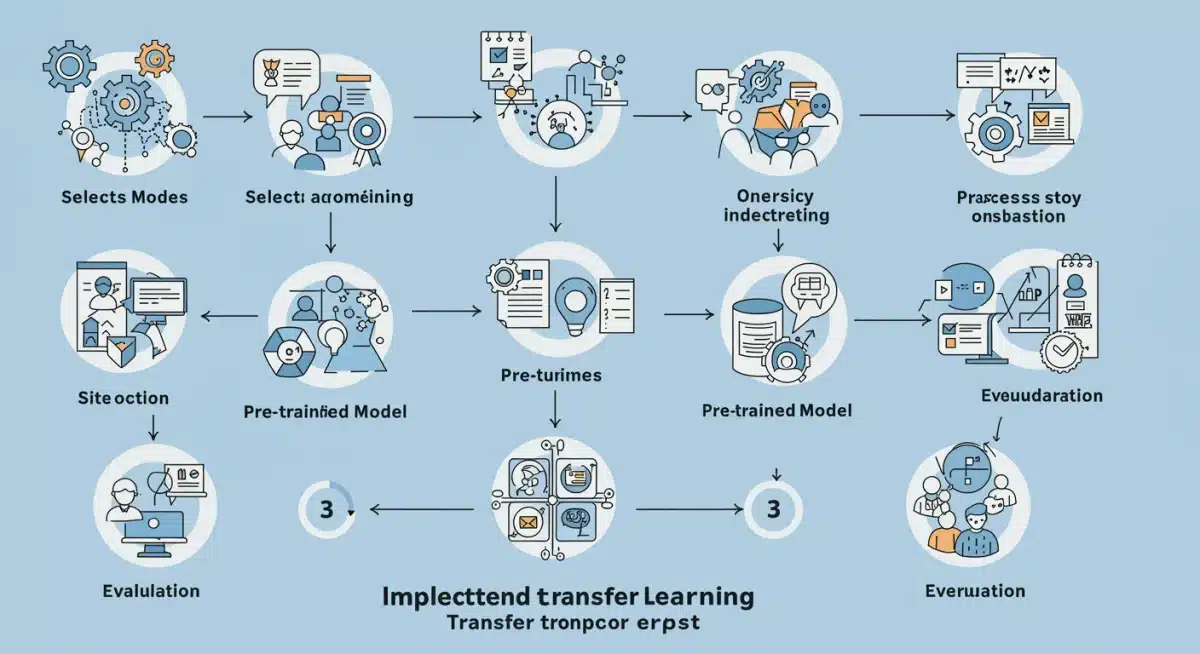
Feature Extraction vs. Fine-tuning: A Strategic Choice
One of the first practical decisions you’ll make is whether to use the pre-trained model as a fixed feature extractor or to fine-tune some of its layers. For very small datasets, especially if they are very different from the source domain, using the model as a feature extractor (freezing all pre-trained layers and training only a new classification head) is often the safest bet to prevent overfitting.
- Feature Extraction: Simpler, faster training, less prone to overfitting on very small datasets.
- Fine-tuning: Potentially higher accuracy, but requires careful hyperparameter tuning and can overfit if not managed well.
If your dataset is slightly larger or more similar to the source domain, fine-tuning a few top layers of the pre-trained model can yield better results. This allows the model to adapt its higher-level features to your specific task while retaining the robust low-level feature detectors. The key is to unfreeze only a few layers and use a very small learning rate to avoid corrupting the pre-trained weights.
Hyperparameter Tuning and Regularization
Even with transfer learning, hyperparameter tuning remains crucial. Experiment with different learning rates, batch sizes, and optimizers. For fine-tuning, a common strategy is to use a significantly smaller learning rate than what would be used for training from scratch. Regularization techniques, such as dropout, L1/L2 regularization, and early stopping, are essential to combat overfitting, which is a major concern with small datasets.
Monitor your model’s performance on a validation set closely. Early stopping, where training is halted when validation performance ceases to improve, is a powerful technique to prevent the model from learning noise in the training data. This iterative process of training, evaluating, and adjusting hyperparameters will be central to optimizing your model’s performance.
Month 3: Advanced Optimization and Performance Evaluation
The final month is dedicated to refining your model, implementing advanced optimization techniques, and rigorously evaluating its performance to ensure it meets the targeted 85% accuracy. This phase often involves more sophisticated strategies to squeeze out every possible performance gain and ensure robustness.
By now, you should have a working model with a reasonable baseline performance. The goal of this month is to push that performance further, often by exploring more aggressive fine-tuning strategies, ensemble methods, or leveraging knowledge distillation. It’s also crucial to perform a thorough error analysis to understand where your model is struggling.
Learning Rate Schedules and Ensemble Methods
Instead of a fixed learning rate, implementing learning rate schedules can significantly improve convergence and final performance. Techniques like learning rate decay, cosine annealing, or cyclical learning rates allow the model to make larger steps in the beginning of training and smaller, more precise adjustments as it converges. This can help the model escape local minima and find better solutions.
- Learning Rate Decay: Gradually reduces the learning rate over epochs.
- Cosine Annealing: Varies the learning rate following a cosine curve.
- Cyclical Learning Rates: Oscillates the learning rate between a lower and upper bound.
Ensemble methods, where multiple models are combined to make predictions, can also boost performance. You could train several variations of your transfer learning model (e.g., with different initializations or slightly different architectures) and average their predictions. This often leads to more robust and accurate results than any single model alone.
Thorough Evaluation and Error Analysis
Achieving 85% performance isn’t just about reaching a number; it’s about understanding what that number means in context. Conduct a thorough evaluation using appropriate metrics (accuracy, precision, recall, F1-score, AUC-ROC, etc., depending on your task). Don’t just look at overall accuracy; analyze performance across different classes, especially if your dataset is imbalanced.
Perform a detailed error analysis. What types of errors is your model making? Are there specific classes it consistently misclassifies? Are there patterns in the misclassified samples? This analysis can reveal opportunities for further data augmentation, targeted preprocessing, or even minor architectural adjustments. Visualizing feature maps or using interpretability tools can also provide insights into why the model makes certain predictions.
Overcoming Challenges with Limited Resources
Working with limited resources, whether it’s computational power, memory, or time, presents its own set of challenges in machine learning. However, transfer learning itself is a resource-efficient strategy. This section dives into specific tactics to further optimize your workflow and achieve high performance even when constraints are tight.
Resource limitations often mean you can’t afford to train massive models from scratch or run extensive hyperparameter searches. This is precisely where the strategic application of transfer learning shines, allowing you to leverage powerful pre-trained models without needing the infrastructure to train them from the ground up.
Memory and Computation Management
When GPU memory is a bottleneck, consider using smaller batch sizes during training. While this might slightly increase training time, it reduces memory footprint. Gradient accumulation is another technique where gradients are accumulated over several mini-batches before a single weight update, effectively simulating a larger batch size without consuming more memory at once. For very large models, techniques like mixed-precision training (using `float16` instead of `float32` where appropriate) can halve memory usage and speed up computations on compatible hardware.
- Smaller Batch Sizes: Reduces GPU memory usage.
- Gradient Accumulation: Simulates larger batches with less memory.
- Mixed-Precision Training: Uses `float16` for memory and speed gains.
Another strategy is to choose smaller, more efficient pre-trained models. Models like MobileNet, EfficientNet-Lite, or SqueezeNet are designed for resource-constrained environments while still offering excellent performance. These models often have fewer parameters and require less computational power for inference and fine-tuning, making them ideal for deployment on edge devices or in situations with limited cloud computing budgets.
Leveraging Cloud Computing and Free Tiers
Even with limited personal resources, cloud computing platforms like Google Colab, Kaggle Kernels, AWS SageMaker Studio Lab, or Azure Machine Learning offer free or low-cost tiers that provide access to GPUs. These platforms can be invaluable for training and experimenting with transfer learning models. Be mindful of their usage limits and optimize your code to make the most of the allocated time and resources.
When using cloud resources, ensure your data pipeline is efficient. Load data in batches, preprocess it effectively, and minimize redundant computations. Saving model checkpoints regularly is also crucial to avoid losing progress if your session disconnects or resources are reclaimed. By strategically utilizing these resources, you can conduct robust experiments and achieve your performance goals.
The Future of Transfer Learning with Small Datasets in 2025
As we look toward 2025, the role of transfer learning, especially for small datasets, is set to become even more pronounced. The continuous development of larger, more generalized foundation models and advancements in adaptation techniques will further democratize AI development, making high-performance models accessible to a broader range of applications and users with limited data.
The trend towards self-supervised learning and unsupervised pre-training is generating models that learn incredibly rich and versatile representations without requiring human-annotated data at scale. These models are inherently powerful candidates for transfer learning, as their learned features are often more robust and generalizable across diverse downstream tasks.
Emerging Trends and Techniques
One significant area of growth is meta-learning, or ‘learning to learn,’ which aims to train models that can rapidly adapt to new tasks with very few examples. This aligns perfectly with the challenges of small datasets. Techniques like Model-Agnostic Meta-Learning (MAML) allow models to learn initialization parameters that are highly adaptable, making fine-tuning on new tasks incredibly efficient.
- Foundation Models: Large, pre-trained models serving as a base for various tasks.
- Self-Supervised Learning: Learning representations from unlabeled data.
- Meta-Learning (Learning to Learn): Training models to adapt quickly to new tasks.
Another promising direction is the development of more sophisticated domain adaptation strategies. These methods are designed to explicitly reduce the discrepancy between source and target data distributions, ensuring that the transferred knowledge is as relevant as possible. This includes adversarial domain adaptation and techniques that learn invariant features across domains.
Democratizing High Performance AI
The ongoing advancements in transfer learning are pivotal in democratizing high-performance AI. Small businesses, researchers with limited budgets, and developers working on niche applications can now achieve state-of-the-art results without needing to collect massive datasets or invest in supercomputing infrastructure. This shifts the focus from raw data volume to intelligent data utilization and model adaptation.
By 2025, we can expect more intuitive tools and platforms that simplify the process of applying transfer learning, making it accessible even to non-experts. The emphasis will be on efficient fine-tuning, robust evaluation, and ethical deployment of these powerful models across various industries, from healthcare to environmental monitoring, enabling innovation at an unprecedented pace.
Practical Tips for Sustained Performance
Achieving 85% performance with transfer learning on small datasets is a significant milestone, but sustaining and even improving upon it requires ongoing attention. This section provides practical tips to ensure your model remains robust, adaptable, and performs optimally over time, especially as new data becomes available or environmental conditions change.
Machine learning models are not static entities; they require maintenance and occasional updates to remain effective. This is particularly true for models trained on small datasets, which can be more sensitive to shifts in data distribution. Proactive monitoring and strategic retraining are key to long-term success.
Continuous Monitoring and Retraining Strategies
Once your model is deployed, continuous monitoring of its performance in a real-world setting is paramount. Track key metrics and look for signs of performance degradation, which could indicate data drift—changes in the input data distribution over time. When significant drift is detected, it’s time to consider retraining your model.
- Performance Monitoring: Track accuracy, precision, recall in production.
- Data Drift Detection: Monitor input data distribution for changes.
- Scheduled Retraining: Periodically retrain with new data to maintain relevance.
Retraining doesn’t necessarily mean starting from scratch. Often, a strategy of incremental fine-tuning on new, labeled data can be sufficient. This involves continuing to train your existing fine-tuned model with a very small learning rate on the newly acquired data. This approach is resource-efficient and helps the model adapt to evolving patterns without forgetting its previously learned knowledge.
Ethical Considerations and Bias Mitigation
Finally, as with any AI application, ethical considerations are crucial. Models, especially those pre-trained on vast, diverse datasets, can inherit biases present in their training data. When applying transfer learning to a new, small dataset, it’s vital to be aware of how these inherited biases might manifest and impact your specific application.
Actively work to mitigate bias by carefully examining your small dataset for representational gaps and applying fairness-aware evaluation metrics. Understanding the limitations and potential biases of your model is not just an ethical imperative but also a practical necessity for building trustworthy and reliable AI systems. A responsible approach ensures that the high performance achieved benefits all users equitably.
| Key Aspect | Brief Description |
|---|---|
| Month 1 Focus | Data preparation, augmentation, and strategic pre-trained model selection. |
| Month 2 Focus | Implementation, feature extraction, initial fine-tuning, and hyperparameter optimization. |
| Month 3 Focus | Advanced optimization, learning rate schedules, ensemble methods, and rigorous evaluation. |
| Resource Management | Strategies for limited computational resources, including batch size, model choice, and cloud tiers. |
Frequently Asked Questions about Transfer Learning
Transfer learning is an ML technique where a model pre-trained on a large dataset for a general task is repurposed for a new, specific task with a smaller dataset. It’s beneficial because it leverages existing knowledge, reducing the need for extensive data and computational resources, and often achieving higher performance than training from scratch.
Data augmentation artificially expands the training dataset by creating modified versions of existing data points (e.g., rotating images, synonym replacement in text). For small datasets, this increases data diversity, helping the model generalize better and reducing the risk of overfitting during the fine-tuning process.
Feature extraction involves using the pre-trained model’s convolutional base to extract features, then training only a new classifier on these features. Fine-tuning involves unfreezing some or all of the pre-trained layers and continuing to train them with a small learning rate on the new dataset, allowing for more specific adaptation.
Yes, achieving 85% performance is entirely feasible with strategic transfer learning even with limited resources. By carefully selecting efficient pre-trained models, employing effective data augmentation, and utilizing free cloud computing tiers, practitioners can optimize their approach to reach high accuracy thresholds.
Emerging trends include the development of larger, more generalized foundation models, advancements in self-supervised learning for robust feature extraction, and meta-learning techniques that enable models to adapt rapidly to new tasks with minimal examples. These innovations promise even greater efficiency and accessibility for AI development.
Conclusion
The 3-month guide to implementing transfer learning for small datasets provides a robust framework for achieving high performance, even with limited resources. By meticulously planning data preparation, judiciously selecting pre-trained models, and systematically fine-tuning, practitioners can unlock significant potential. The journey from foundational understanding to advanced optimization and continuous monitoring ensures not only the attainment of performance targets like 85% accuracy but also the development of adaptable and ethically sound AI solutions for the future. The accessibility and efficiency of transfer learning continue to democratize AI, empowering a wider range of innovators to leverage its power effectively.