AI-Powered Sales Forecasting: Boost 2026 Q3 Revenue by 15% for U.S. Businesses

Boost Your 2026 Q3 Revenue by 15% with AI-Powered Sales Forecasting: A Practical Guide for U.S. Businesses
In the fiercely competitive landscape of modern business, staying ahead requires more than just intuition; it demands precision, foresight, and adaptability. For U.S. businesses aiming for substantial growth, particularly a challenging yet achievable 15% revenue increase in Q3 2026, the traditional methods of sales forecasting are simply no longer sufficient. Enter AI Sales Forecasting – a transformative technology poised to revolutionize how companies predict future sales, optimize strategies, and ultimately, drive unprecedented financial success.
This comprehensive guide delves deep into the world of AI-powered sales forecasting, providing U.S. businesses with a practical roadmap to not only understand but also successfully implement this cutting-edge solution. We will explore the fundamental principles, the tangible benefits, the step-by-step process of integration, and the critical factors for maximizing your return on investment. By the end of this article, you’ll have a clear understanding of how to harness the power of AI to confidently project sales, allocate resources effectively, and achieve your ambitious revenue targets for 2026 Q3 and beyond.
The Imperative for AI Sales Forecasting in Today’s Market
The global economy is characterized by rapid shifts, unpredictable consumer behavior, and an overwhelming volume of data. In such an environment, relying on historical averages or simplistic linear models for sales forecasting is akin to navigating a complex maze blindfolded. Errors in forecasting can lead to a cascade of negative consequences: overstocking or understocking inventory, inefficient resource allocation, missed sales opportunities, and ultimately, a significant impact on profitability.
For U.S. businesses, the stakes are particularly high. The domestic market is diverse and dynamic, influenced by regional economic trends, evolving regulatory landscapes, and a highly informed consumer base. Achieving a 15% revenue boost in a single quarter, such as Q3 2026, necessitates a forecasting methodology that can not only process vast datasets but also identify nuanced patterns and predict future outcomes with a high degree of accuracy. This is precisely where AI Sales Forecasting excels.
AI models, particularly those leveraging machine learning, can analyze a multitude of variables that human analysts might overlook or find too complex to synthesize. These variables include:
- Historical Sales Data: Beyond just volume, AI can identify seasonality, trends, and cyclical patterns.
- Economic Indicators: GDP growth, inflation rates, unemployment figures, and consumer confidence indices.
- Market Trends: Industry-specific growth, competitor activities, and emerging consumer preferences.
- Promotional Activities: The impact of past marketing campaigns, discounts, and advertising spend.
- External Factors: Weather patterns, social media sentiment, geopolitical events, and supply chain disruptions.
- Website Traffic and Engagement: Digital footprints that can signal future purchasing intent.
By integrating and analyzing these disparate data sources, AI can generate forecasts that are not only more accurate but also more adaptable to changing market conditions. This enhanced accuracy translates directly into more informed decision-making, allowing businesses to optimize their sales strategies, inventory management, marketing efforts, and operational efficiency, all contributing to the ambitious goal of a 15% revenue increase.
Understanding the Mechanics of AI Sales Forecasting
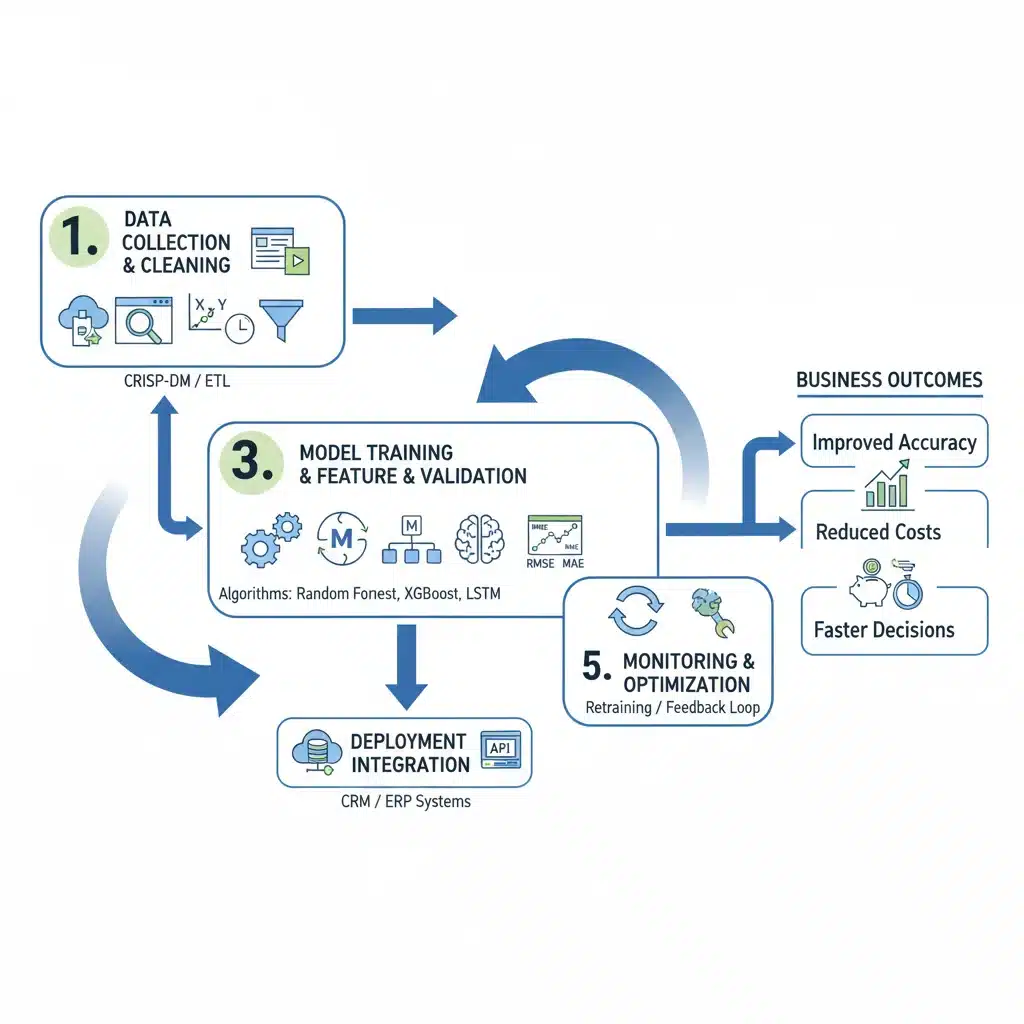
At its core, AI Sales Forecasting utilizes advanced algorithms and machine learning techniques to predict future sales performance. Unlike traditional statistical methods, AI models can learn from data, identify complex non-linear relationships, and continuously improve their accuracy over time as they are fed more information. The process typically involves several key stages:
1. Data Collection and Preparation
The foundation of any effective AI model is high-quality data. This involves gathering relevant information from various internal and external sources. Internal data might include CRM records, ERP systems, website analytics, and POS data. External data could encompass economic forecasts, social media trends, competitor data, and even weather patterns. Crucially, this data must be cleaned, normalized, and preprocessed to remove inconsistencies, handle missing values, and ensure it’s in a format suitable for AI analysis.
2. Feature Engineering
This stage involves transforming raw data into features that are most relevant and informative for the AI model. For instance, instead of just using a date, features like ‘day of the week,’ ‘month,’ ‘quarter,’ ‘holiday indicator,’ or ‘number of days since last promotion’ could be engineered. This step is vital for helping the AI model identify crucial patterns that influence sales.
3. Model Selection and Training
There are various AI and machine learning algorithms suitable for sales forecasting, each with its strengths. Common choices include:
- Regression Models: Linear regression, polynomial regression for identifying relationships between variables.
- Time Series Models: ARIMA, SARIMA, Prophet for analyzing time-dependent data and seasonal patterns.
- Machine Learning Algorithms: Random Forests, Gradient Boosting Machines (XGBoost, LightGBM), Support Vector Machines for handling complex, non-linear relationships and large datasets.
- Deep Learning Models: Recurrent Neural Networks (RNNs) and Long Short-Term Memory (LSTMs) for highly complex sequential data, often used in scenarios with very long historical trends or unstructured data.
The selected model is then trained using historical data, where it learns to identify patterns and relationships between input features and past sales outcomes. This training phase is iterative, often involving hyperparameter tuning to optimize model performance.
4. Model Evaluation and Validation
Once trained, the model’s performance is rigorously evaluated using metrics such as Mean Absolute Error (MAE), Root Mean Squared Error (RMSE), Mean Absolute Percentage Error (MAPE), and R-squared. This involves testing the model on unseen data (validation set) to ensure it generalizes well and isn’t overfitting to the training data. Continuous validation is essential to maintain accuracy.
5. Deployment and Monitoring
After successful validation, the AI model is deployed into a production environment, often integrated with existing CRM or ERP systems. This allows for automated forecasting. However, the process doesn’t end there. AI models require continuous monitoring to ensure their accuracy doesn’t degrade over time due to concept drift (changes in underlying data patterns) or data quality issues. Regular retraining with new data is also crucial for sustained performance.
Key Benefits of Implementing AI Sales Forecasting for U.S. Businesses
The advantages of adopting AI Sales Forecasting extend far beyond mere prediction. For U.S. businesses, these benefits translate directly into a competitive edge and a clear path to achieving that 15% revenue increase in Q3 2026:
1. Unprecedented Accuracy and Precision
AI models can process and interpret vast amounts of data, identifying subtle correlations and trends that human analysts or simpler statistical models might miss. This leads to significantly more accurate sales predictions, reducing forecast errors and providing a clearer picture of future demand. Higher accuracy means better inventory management, reduced waste, and optimized production schedules.
2. Enhanced Decision-Making
With reliable forecasts, business leaders can make more informed strategic decisions. This includes everything from setting realistic sales targets and allocating marketing budgets more effectively to optimizing pricing strategies and planning for workforce expansion or contraction. The clarity provided by AI forecasts empowers proactive rather than reactive management.
3. Optimized Resource Allocation
Knowing what to expect allows businesses to allocate their resources – be it inventory, staff, marketing spend, or production capacity – with greater efficiency. This prevents overstocking (tying up capital) and understocking (missing sales opportunities), ensuring that resources are deployed where they will have the greatest impact on revenue.
4. Improved Customer Satisfaction
Accurate forecasts help ensure products are available when customers want them, reducing lead times and stockouts. This directly contributes to higher customer satisfaction and loyalty, which are crucial drivers of long-term revenue growth.
5. Identification of New Opportunities and Risks
AI can uncover hidden patterns and emerging trends within your data that might indicate new market opportunities or potential risks. For example, it might identify a nascent demand for a specific product in a particular region, allowing you to capitalize on it before competitors. Conversely, it can signal declining demand or an upcoming market saturation, enabling proactive adjustments.
6. Competitive Advantage
Businesses that leverage AI for sales forecasting gain a significant competitive edge. They can react faster to market changes, optimize their operations more effectively, and consistently outperform competitors relying on outdated forecasting methods. This agility is paramount in today’s fast-paced business environment.
7. Scalability and Efficiency
Once implemented, AI forecasting systems can process data and generate predictions at scale, significantly reducing the manual effort and time required for traditional forecasting. This frees up human talent to focus on strategic analysis, relationship building, and innovative problem-solving, rather than tedious data crunching.
A Practical Roadmap for Implementing AI Sales Forecasting
Achieving a 15% revenue increase in Q3 2026 through AI Sales Forecasting requires a structured and thoughtful approach. Here’s a practical roadmap for U.S. businesses:
Step 1: Define Clear Objectives and KPIs
Before diving into technology, clearly articulate what you want to achieve. Is it a 15% revenue increase? A 20% reduction in inventory holding costs? Improved forecast accuracy by X percentage? Define key performance indicators (KPIs) to measure success. For Q3 2026, your primary objective is a 15% revenue boost, so all efforts should align with this goal.
Step 2: Assess Your Data Landscape
Conduct a thorough audit of your existing data sources. Identify what data you have, its quality, completeness, and accessibility. This includes CRM data, ERP data, marketing automation platforms, website analytics, economic data, and any other relevant external sources. Pinpoint any data gaps or quality issues that need addressing.
Step 3: Build a Cross-Functional Team
Successful AI implementation is a team sport. Assemble a team comprising data scientists, business analysts, sales managers, IT specialists, and relevant stakeholders from finance and operations. Their collective expertise will ensure the project aligns with business goals and is technically sound.
Step 4: Choose the Right Technology and Partner
Decide whether to build an in-house solution (requiring significant data science expertise) or leverage a third-party AI sales forecasting platform. For many U.S. businesses, especially SMEs, partnering with an experienced vendor can accelerate deployment and provide access to specialized knowledge. Evaluate solutions based on scalability, integration capabilities, accuracy, ease of use, and cost.
Step 5: Data Integration and Preprocessing
This is arguably the most critical and often the most time-consuming step. Integrate all relevant data sources into a centralized, clean, and consistent format. Implement robust data governance practices to ensure ongoing data quality. This might involve setting up data pipelines, data warehouses, or data lakes.
Step 6: Model Development and Training
Work with your data science team or vendor to select, train, and fine-tune the appropriate AI models using your historical data. This iterative process involves experimentation with different algorithms and parameters to achieve the highest possible accuracy for your specific business context.
Step 7: Pilot Program and Validation
Before a full-scale rollout, implement the AI forecasting system in a pilot program, perhaps for a specific product line, region, or sales team. Compare AI-generated forecasts with actual sales outcomes and traditional forecasts. Gather feedback from users and iterate on the model and processes based on these insights.
Step 8: Full-Scale Deployment and Integration
Once validated, integrate the AI sales forecasting system seamlessly into your daily operations. This might involve integrating it with your CRM for sales team access, ERP for inventory planning, and marketing automation for campaign optimization. Ensure smooth data flow and user accessibility.
Step 9: Continuous Monitoring and Optimization
AI Sales Forecasting is not a set-it-and-forget-it solution. Regularly monitor the model’s performance, compare forecasts against actuals, and retrain your model with new data periodically. Market conditions change, and your AI model must evolve with them to maintain its predictive power. Establish a feedback loop where sales teams can provide insights to further refine the model.
Overcoming Challenges in AI Sales Forecasting Implementation
While the benefits are substantial, implementing AI Sales Forecasting is not without its challenges. U.S. businesses should be prepared to address these potential hurdles:
1. Data Quality and Availability
Poor data quality, missing data, or fragmented data sources can severely hamper the accuracy of AI models. Investing in data governance, data cleaning tools, and a robust data infrastructure is paramount.
2. Lack of Internal Expertise
Many businesses may not have the in-house data science or AI engineering talent required to build and maintain sophisticated forecasting models. This can be mitigated by hiring specialized talent, upskilling existing staff, or partnering with external AI solution providers.
3. Resistance to Change
Sales teams and management accustomed to traditional forecasting methods might be resistant to adopting new AI-driven approaches. Effective change management, clear communication of benefits, and involving users in the implementation process are crucial for fostering adoption.
4. Model Interpretability
Some advanced AI models, particularly deep learning networks, can be black boxes, making it difficult to understand how they arrive at their predictions. For business users, this lack of interpretability can be a barrier to trust. Prioritizing explainable AI (XAI) techniques or choosing models that offer a balance between accuracy and interpretability can help.
5. Integration Complexities
Integrating a new AI system with existing legacy IT infrastructure can be complex and time-consuming. Planning for integration early and opting for solutions with robust API capabilities can streamline this process.
6. Cost of Implementation and Maintenance
Initial investments in AI technology, data infrastructure, and talent can be significant. However, it’s essential to view these as strategic investments that yield substantial ROI through increased revenue and operational efficiencies. A clear business case demonstrating the potential for a 15% revenue boost in Q3 2026 can justify these costs.
Realizing the 15% Revenue Boost in Q3 2026: Strategies and Best Practices
To successfully achieve your ambitious goal of a 15% revenue increase in Q3 2026 using AI Sales Forecasting, consider these strategies and best practices:
1. Integrate Forecasts Across All Departments
Don’t let your AI forecasts sit in a silo. Share insights proactively with sales, marketing, operations, finance, and supply chain teams. When all departments operate with a unified, data-driven view of future demand, strategic alignment improves dramatically, leading to optimized campaigns, inventory, and resource allocation.
2. Dynamic Pricing and Promotion Optimization
Leverage AI forecasts to implement dynamic pricing strategies. If AI predicts a surge in demand, adjust pricing to maximize revenue. Conversely, if demand is expected to dip, strategically timed promotions can stimulate sales without significant margin erosion. AI can also optimize promotional spend by predicting which campaigns will yield the highest ROI.
3. Targeted Marketing and Sales Efforts
AI can segment customers based on their predicted likelihood to purchase specific products or services. Use these insights to craft highly targeted marketing campaigns and empower your sales team to focus on the most promising leads and opportunities. This precision reduces wasted effort and increases conversion rates.
4. Proactive Inventory and Supply Chain Management
Accurate forecasts allow for just-in-time inventory management, reducing carrying costs and minimizing stockouts. This is particularly crucial for businesses with seasonal products or complex supply chains. Predictive insights can also help anticipate and mitigate potential supply chain disruptions.
5. Continuous Learning and Adaptation
The market is constantly evolving. Your AI models must evolve too. Regularly review the accuracy of your forecasts, analyze discrepancies, and retrain your models with the latest data. Incorporate feedback from sales teams on market dynamics not captured by data. This iterative process ensures your AI Sales Forecasting remains sharp and relevant.
6. Focus on Explainability and Trust
Ensure your sales teams and decision-makers understand how the AI arrives at its forecasts. Provide visualizations and clear explanations of the key drivers influencing predictions. Building trust in the AI system is essential for its widespread adoption and effective utilization. When users trust the data, they are more likely to act on its insights.
7. Don’t Replace Human Insight, Augment It
AI is a powerful tool, but it’s not a replacement for human expertise. Sales professionals bring invaluable qualitative insights, customer relationships, and market intuition. The most successful implementations combine the predictive power of AI with the strategic thinking and experience of your human teams. AI should augment, not automate, the entire sales forecasting process.

The Future of Sales: AI as a Strategic Imperative
As we look towards 2026 Q3 and beyond, the role of AI Sales Forecasting will only become more pronounced. Businesses that embrace this technology early will gain a significant, lasting advantage. The ability to accurately predict sales, understand market dynamics, and optimize operations with data-driven precision is no longer a luxury but a strategic imperative.
For U.S. businesses, the opportunity to achieve a 15% revenue increase in Q3 2026 is not merely a wish; it’s an achievable goal with the intelligent application of AI. By investing in the right technology, fostering a data-driven culture, and empowering your teams with actionable insights, you can navigate future challenges with confidence and unlock new levels of growth and profitability.
Start your journey today by assessing your current forecasting capabilities, identifying data opportunities, and exploring how AI can transform your sales predictions. The future of your revenue growth is predictable, and it’s powered by AI.