
In the rapidly evolving landscape of artificial intelligence, Machine Learning (ML) pipelines have become the backbone of innovation and competitive advantage for businesses across the United States. From predictive analytics to autonomous systems, ML models are transforming industries at an unprecedented pace. However, with great power comes great responsibility, especially concerning the security of these complex systems. The year 2026 promises even more sophisticated ML applications, but also more sophisticated threats. Ensuring robust ML Pipeline Security is no longer an option but a critical imperative for any organization engaged in AI development.
The stakes are incredibly high. A compromised ML pipeline can lead to data breaches, intellectual property theft, model manipulation, and ultimately, a catastrophic loss of trust and financial damage. As US AI development continues to accelerate, adversaries, both state-sponsored and independent, are increasingly targeting these valuable assets. This comprehensive guide will delve into the top five cybersecurity practices essential for fortifying your ML pipelines against the threats of today and tomorrow, ensuring the integrity, confidentiality, and availability of your AI initiatives.
The Evolving Threat Landscape for Machine Learning
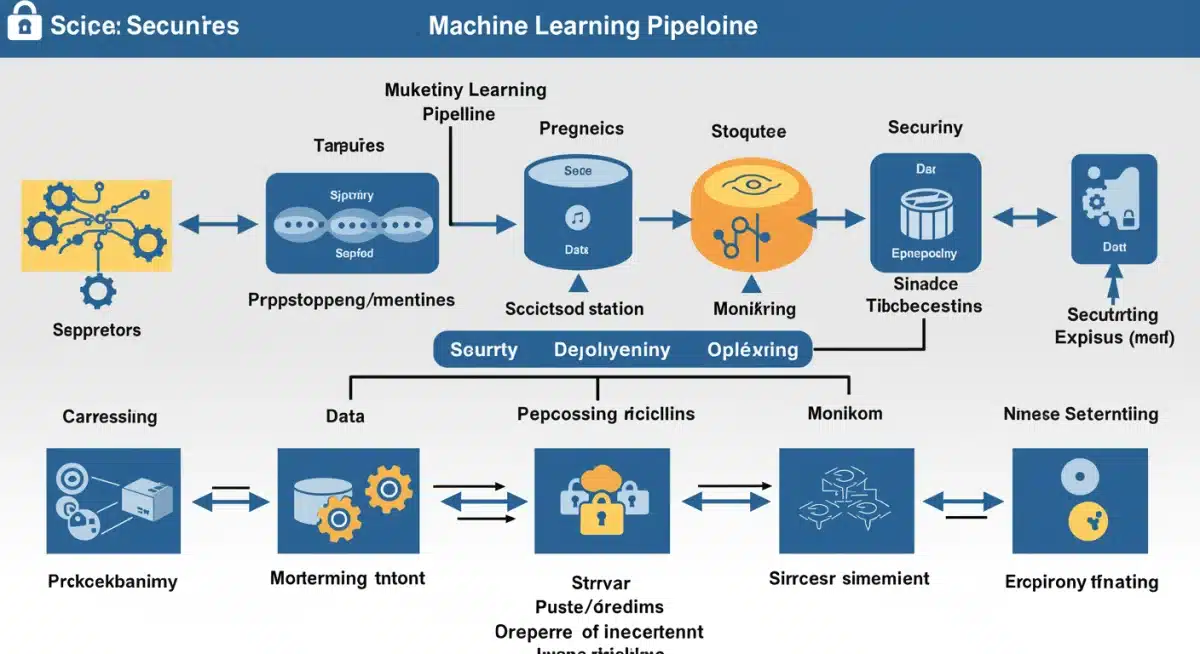
Before we dive into specific practices, it’s crucial to understand why ML Pipeline Security demands specialized attention. Traditional cybersecurity measures, while foundational, often fall short when confronted with the unique vulnerabilities inherent in ML systems. These vulnerabilities span the entire lifecycle, from data acquisition and preprocessing to model training, deployment, and ongoing monitoring. Attack vectors can be broadly categorized into:
- Data Poisoning: Malicious actors inject corrupted or biased data into the training set, leading to flawed or manipulated model behavior.
- Model Evasion: Adversaries craft inputs specifically designed to bypass a deployed model’s detection capabilities without altering the model itself.
- Model Inversion/Extraction: Attackers attempt to reconstruct sensitive training data or extract the underlying model architecture and parameters.
- Adversarial Attacks: Subtle, often imperceptible perturbations to input data can cause a model to misclassify with high confidence.
- Infrastructure Vulnerabilities: Exploiting weaknesses in the underlying cloud infrastructure, MLOps platforms, or data storage solutions.
The sophistication of these attacks is growing, often leveraging AI against AI. Therefore, a multi-layered, proactive approach to ML Pipeline Security is indispensable. Let’s explore the key practices.
1. Implement Robust Data Governance and Anomaly Detection
At the heart of every ML pipeline lies data. The quality, integrity, and security of this data are paramount. Any compromise at the data layer can propagate through the entire system, leading to biased models, inaccurate predictions, or even catastrophic failures. Robust data governance is the bedrock of effective ML Pipeline Security.
Data Ingestion and Validation
The first line of defense is rigorous validation of all incoming data. Implement strict schema validation, data type checks, and range constraints. Utilize cryptographic hashes and digital signatures to verify data origin and ensure it hasn’t been tampered with during transit. For sensitive data, employ techniques like differential privacy and homomorphic encryption where feasible, especially during collection and preprocessing stages. This helps protect individual privacy while still allowing the data to be used for training.
Access Control and Encryption
Strict access controls (Role-Based Access Control – RBAC) must be enforced for all data stores. Only authorized personnel and services should have access to specific datasets, and access should be granted on a ‘need-to-know’ and ‘least privilege’ basis. All data, both at rest and in transit, must be encrypted using strong, industry-standard algorithms. This includes databases, data lakes, object storage, and communication channels between different components of the ML pipeline.
Anomaly Detection in Data Streams
Beyond static validation, dynamic anomaly detection mechanisms are crucial. Implement systems that continuously monitor data streams for unusual patterns, sudden shifts in distribution, or suspicious outliers that could indicate a data poisoning attack. Machine learning models themselves can be used to detect anomalies in incoming data, creating a self-defending mechanism. This includes monitoring data drift, concept drift, and unexpected feature distributions that deviate significantly from historical norms. Early detection of such anomalies can prevent corrupted data from ever reaching the training phase, thereby safeguarding model integrity and ensuring robust ML Pipeline Security.
2. Secure Model Development and Training Environments
The environment where ML models are developed and trained is a critical attack surface. Protecting this environment is vital to prevent intellectual property theft, model manipulation, and the introduction of malicious code. This practice focuses on securing the computational resources, code repositories, and development workflows.
Isolated and Hardened Environments
ML training often requires significant computational resources. These environments, whether on-premises or cloud-based, must be isolated from less secure networks and hardened against external threats. This includes using virtual private clouds (VPCs), network segmentation, and stringent firewall rules. Regularly patch and update all operating systems, libraries, and frameworks used in the development environment. Conduct penetration testing and vulnerability assessments frequently to identify and remediate weaknesses.
Code Security and Version Control
All model code, scripts, and configuration files should be stored in secure version control systems (e.g., Git) with multi-factor authentication (MFA) and strict access controls. Implement code review processes to identify potential vulnerabilities, backdoors, or malicious insertions. Utilize static application security testing (SAST) and dynamic application security testing (DAST) tools to scan code for known security flaws. Ensure that all dependencies and third-party libraries are vetted for security vulnerabilities and periodically updated.
Provenance and Reproducibility
Maintaining a clear audit trail of model development is essential for both debugging and security. Track every change to the code, data, and hyperparameters. Tools for ML experiment tracking can help record the exact data used, code versions, and environment configurations for each model run. This provenance allows for reproducibility and helps identify if a deployed model’s behavior has deviated due to unauthorized changes during training. Secure logging and monitoring of training activities are also critical to detect suspicious behavior, such as unauthorized access attempts or unusual resource consumption, which could indicate a breach in ML Pipeline Security.
3. Strengthen Model Deployment and Inference Security
Once an ML model is trained, its deployment into production introduces a new set of security challenges. Protecting the deployed model and its inference endpoints from adversarial attacks and unauthorized access is paramount. This stage of ML Pipeline Security is where models interact directly with users or other systems, making it a prime target for exploitation.
Secure API Endpoints
ML models are typically exposed via API endpoints for inference. These endpoints must be secured with strong authentication and authorization mechanisms (e.g., OAuth, API keys, JWTs). Implement rate limiting to prevent denial-of-service (DoS) attacks and brute-force attempts. Use Web Application Firewalls (WAFs) to filter malicious traffic and protect against common web vulnerabilities. All communication with the API should be encrypted using TLS/SSL.
Adversarial Robustness and Monitoring
Deployed models are highly susceptible to adversarial attacks. While complete immunity is often unattainable, measures can be taken to improve robustness. This includes adversarial training, where models are exposed to adversarial examples during training to make them more resilient. Implement continuous monitoring of model inputs and outputs in production. Look for statistical anomalies, unusual input patterns, or sudden drops in model confidence that could indicate an ongoing evasion attack. Tools for detecting data drift and concept drift in production can also serve as early warning systems for adversarial manipulation or data quality issues affecting model performance. Real-time monitoring and alerting are crucial for swift response to potential threats to ML Pipeline Security.
Model Obfuscation and Intellectual Property Protection
While not a foolproof solution, techniques like model obfuscation (e.g., pruning, quantization) can make it harder for attackers to extract or reverse-engineer the model. For highly sensitive models, consider using specialized hardware (e.g., Trusted Execution Environments – TEEs) or federated learning approaches where the model itself never leaves a secure enclave or raw data is not centralized. Protecting the intellectual property embedded within your models is a significant aspect of overall ML Pipeline Security, especially in a competitive landscape like US AI development.
4. Implement Comprehensive MLOps Security Best Practices
MLOps (Machine Learning Operations) is the discipline of managing the entire ML lifecycle, from experimentation to deployment and maintenance. Integrating security into every stage of MLOps is critical for a holistic approach to ML Pipeline Security. This means automating security checks and controls throughout the CI/CD (Continuous Integration/Continuous Delivery) pipeline for ML.
Automated Security Scanning in CI/CD
Integrate automated security scanning tools into your CI/CD pipelines. This includes vulnerability scanning for Docker images, dependency scanning for libraries, and static/dynamic code analysis for ML code. Every time a change is committed or a new model version is built, these scans should run automatically, identifying potential issues before they reach production. Automated tests should also include adversarial attack simulations to assess model robustness.
Infrastructure as Code (IaC) Security
If your infrastructure is provisioned using IaC (e.g., Terraform, CloudFormation), ensure that security best practices are baked into your templates from the start. Regularly audit IaC configurations for misconfigurations, overly permissive access policies, and adherence to security baselines. Tools that scan IaC for security vulnerabilities can be integrated into your CI/CD pipeline, ensuring that the underlying infrastructure supporting your ML pipeline is secure by design.
Continuous Monitoring and Incident Response
Beyond data and model monitoring, comprehensive monitoring of the entire MLOps infrastructure is essential. This includes logging all activities, monitoring system health, and tracking resource utilization. Establish robust incident response plans specifically tailored for ML pipeline incidents. This involves defining clear roles and responsibilities, establishing communication protocols, and having playbooks for responding to data poisoning, model evasion, or infrastructure breaches. Regular drills and tabletop exercises can help refine these plans, ensuring a swift and effective response to any security incident impacting ML Pipeline Security.
5. Foster a Culture of Security Awareness and Training
Even the most advanced technological safeguards can be undermined by human error or negligence. A strong security culture is an indispensable component of effective ML Pipeline Security. This involves continuous education, clear policies, and a mindset where security is everyone’s responsibility.
Regular Security Training for ML Teams
Data scientists, ML engineers, and MLOps professionals need specialized security training that goes beyond general cybersecurity awareness. This training should cover unique ML-specific threats, common attack vectors, secure coding practices for ML, and the importance of data privacy and ethical AI. Educate teams on the risks of using unverified open-source libraries, the implications of data leakage, and the principles of least privilege. Regular refreshers are crucial as the threat landscape evolves.
Establishing Clear Security Policies and Guidelines
Develop and disseminate clear, actionable security policies and guidelines specifically for ML development and deployment. These policies should cover data handling, model versioning, access control, incident reporting, and the use of approved tools and platforms. Ensure that all team members understand their responsibilities and the consequences of non-compliance. These policies should align with relevant industry standards and regulatory requirements, such as NIST AI Risk Management Framework or specific regulations governing data privacy in the US.
Promoting a Security-First Mindset
Encourage a proactive security-first mindset throughout the organization. This means integrating security considerations from the very beginning of the ML lifecycle – ‘security by design’. Foster an environment where team members are comfortable reporting potential vulnerabilities or suspicious activities without fear of reprisal. Implement rewards or recognition programs for individuals who contribute significantly to improving ML Pipeline Security. Regular communication from leadership reinforcing the importance of security can significantly bolster this culture.

The Future of ML Pipeline Security in US AI Development
As we look towards 2026 and beyond, the complexity of ML models and the scale of their deployment will only increase. This will inevitably lead to more sophisticated attacks, requiring continuous adaptation and innovation in security practices. The US AI development sector, a global leader, must prioritize proactive and comprehensive ML Pipeline Security to maintain its competitive edge and ensure public trust in AI technologies.
Emerging trends such as homomorphic encryption, federated learning, and explainable AI (XAI) will play increasingly important roles in enhancing security and transparency. Homomorphic encryption could allow computations on encrypted data, significantly boosting data privacy. Federated learning enables collaborative model training without centralizing sensitive data, mitigating data breach risks. XAI, by making models more interpretable, can help in identifying and debugging malicious model behaviors or biases introduced by adversarial attacks.
Furthermore, regulatory bodies are likely to introduce more stringent requirements for AI security and ethics. Organizations that embed robust security practices now will be better positioned to meet these future compliance challenges. Investing in skilled cybersecurity professionals with expertise in AI and ML is also critical. The talent gap in this specialized area needs to be addressed through training programs and collaboration between academia and industry.
Collaboration within the industry is also key. Sharing threat intelligence, best practices, and innovative security solutions can create a collective defense against common adversaries. Open-source initiatives focused on ML security tools and frameworks will also contribute significantly to strengthening the overall ecosystem. The goal is not just to react to threats but to anticipate them, building resilient and secure ML pipelines that can withstand the evolving pressures of the digital age.
Conclusion
Securing Machine Learning pipelines is a multifaceted challenge that requires a holistic and continuous effort. By focusing on robust data governance, secure development environments, fortified deployment strategies, comprehensive MLOps security, and a strong security-aware culture, organizations can significantly enhance their ML Pipeline Security. In the competitive and high-stakes arena of US AI development, these practices are not merely recommendations; they are foundational pillars for innovation, trust, and sustained success. As AI continues to reshape our world, the commitment to securing its underlying infrastructure, particularly ML pipelines, will define the reliability and ethical deployment of future intelligent systems. Proactive security measures today will safeguard the AI advancements of tomorrow, ensuring that the promise of artificial intelligence is realized responsibly and securely for the benefit of all.