Mastering Federated Learning: 5 Strategies for Data Privacy in 2026 AI Deployments Across the US

In an era increasingly defined by data, artificial intelligence (AI) has emerged as a transformative force, reshaping industries and daily life. However, the immense power of AI comes with a significant responsibility: safeguarding the privacy of the data it consumes. As we look towards 2026, the landscape of AI deployments, particularly across the United States, is becoming more complex, with stringent regulations and heightened public awareness around data protection. This is where Federated Learning Strategies become not just advantageous, but absolutely essential.
Federated learning, a decentralized machine learning approach, allows AI models to be trained on data distributed across multiple devices or organizations without centralizing the raw data. This innovative paradigm offers a compelling solution to the privacy challenges inherent in traditional AI development. Instead of bringing data to the model, federated learning brings the model to the data, enabling collaborative AI without compromising sensitive information. The implications for sectors like healthcare, finance, and smart cities are profound, promising breakthrough innovations while adhering to privacy mandates like HIPAA, GDPR (though primarily European, its principles influence US practices), and emerging state-specific privacy laws.
This article will delve into five critical Federated Learning Strategies that will be pivotal for ensuring robust data privacy in AI deployments across the US by 2026. We will explore how these strategies can be implemented, their benefits, and the challenges they address, providing a comprehensive guide for organizations navigating the complex intersection of AI innovation and data privacy.
Understanding the Imperative: Why Federated Learning is Key for US AI Privacy in 2026
The United States, a global leader in AI innovation, also faces unique challenges regarding data privacy. A patchwork of state-level regulations, such as the California Consumer Privacy Act (CCPA) and its successor CPRA, Virginia’s CDPA, and Colorado’s CPA, alongside sector-specific laws, creates a complex compliance environment. Traditional AI models often require vast, centralized datasets, posing significant risks of data breaches, re-identification attacks, and non-compliance with these diverse regulations. This is where Federated Learning Strategies step in as a game-changer.
By keeping data localized on individual devices or within organizational silos, federated learning inherently reduces the risk of mass data exposure. Only model updates or aggregated insights, not raw data, are shared with a central server, significantly enhancing privacy. This distributed approach not only addresses regulatory concerns but also fosters trust among data owners, encouraging collaboration on AI projects that might otherwise be impossible due to data sensitivity. The ability to train powerful AI models on diverse, real-world data without direct access to it unlocks new possibilities for innovation in highly regulated industries, making federated learning an indispensable component of future-proof AI strategies.
Furthermore, the edge computing revolution is driving more data processing closer to the source. Federated learning naturally aligns with this trend, allowing AI models to learn from data generated on devices like smartphones, IoT sensors, and local servers, thereby minimizing latency and bandwidth requirements. This synergy between federated learning and edge computing will be crucial for scalable and efficient AI deployments across the vast geographical and technological landscape of the US.
The demand for privacy-preserving AI is not just a regulatory mandate; it’s a market differentiator. Consumers and businesses are increasingly prioritizing privacy, making solutions that respect data boundaries more appealing. Organizations that master Federated Learning Strategies will not only mitigate legal risks but also build stronger customer trust and gain a competitive edge in the rapidly evolving AI market of 2026 and beyond.
Strategy 1: Robust Differential Privacy Mechanisms
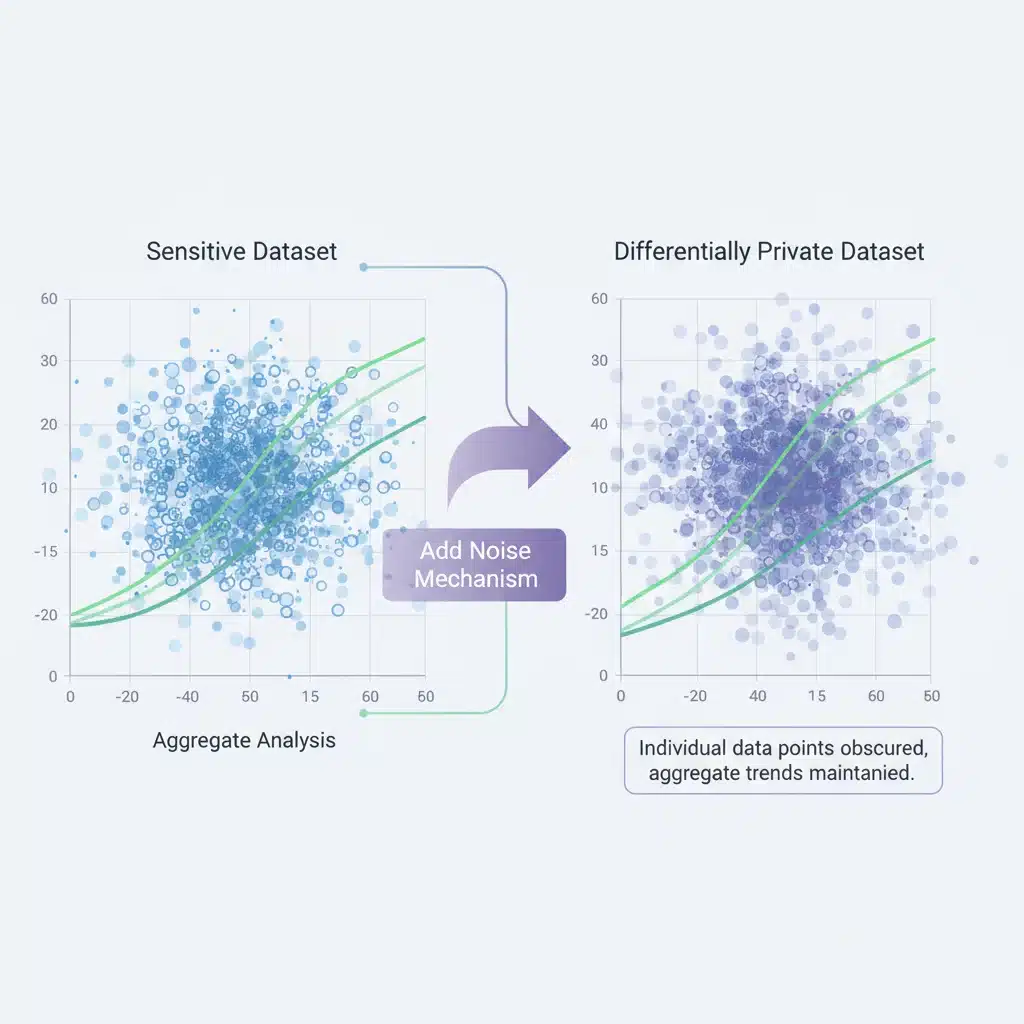
One of the most powerful Federated Learning Strategies for ensuring data privacy is the integration of differential privacy. Differential privacy is a rigorous mathematical framework that provides strong guarantees about the privacy of individuals within a dataset. It achieves this by introducing carefully calibrated noise into the data or the model updates, making it statistically impossible to infer information about any single individual’s data contribution.
In the context of federated learning, differential privacy can be applied at two main levels: client-side and server-side. Client-side differential privacy involves adding noise to the local model updates before they are sent to the central server. This ensures that even if a malicious actor intercepts the updates, they cannot reconstruct individual data points. Server-side differential privacy, on the other hand, adds noise to the aggregated model updates before they are distributed to clients or used for final model training. Both approaches contribute significantly to strengthening privacy guarantees.
Implementing differential privacy requires a careful balance between privacy protection and model utility. Too much noise can degrade the accuracy of the AI model, while too little noise might not provide sufficient privacy. Advanced research is continually optimizing noise injection techniques and adaptive privacy budgets to achieve this balance effectively. For US AI deployments, where data sensitivity varies across sectors, the flexibility of differential privacy allows for tailored privacy levels, making it a cornerstone of secure federated AI.
Consider a healthcare scenario: training an AI model on patient data from multiple hospitals. With differential privacy, each hospital can train a local model and send noisy updates to a central server. The aggregate model learns from the collective data patterns without revealing any individual patient’s records, thus complying with strict HIPAA regulations and safeguarding patient confidentiality. This strategy is not just theoretical; it’s being actively researched and deployed in real-world applications, proving its efficacy as a leading privacy-preserving technique.
Strategy 2: Secure Aggregation Protocols
Another crucial element among effective Federated Learning Strategies is the implementation of secure aggregation protocols. While differential privacy focuses on obscuring individual contributions, secure aggregation ensures that the central server (or aggregator) cannot inspect individual client model updates at all, only their combined sum. This is achieved through cryptographic techniques that allow multiple parties to compute a sum over their private inputs without revealing their inputs to each other or to the aggregator.
One prominent technique is Secure Multi-Party Computation (SMC). SMC protocols enable multiple parties to jointly compute a function over their private inputs while keeping those inputs secret. In federated learning, this means that clients can encrypt their local model updates, and a secure aggregation protocol can compute the sum of these encrypted updates. The aggregator then receives only the aggregated, encrypted sum, which can then be decrypted to obtain the final global model update, without ever seeing the individual contributions.
The complexity of secure aggregation lies in its computational overhead. Cryptographic operations can be resource-intensive, potentially slowing down the training process. However, ongoing research is yielding more efficient and scalable secure aggregation protocols, making them increasingly practical for large-scale federated deployments. Homomorphic encryption, for instance, allows computations to be performed on encrypted data without decrypting it first, offering another powerful avenue for secure aggregation, though it also comes with its own computational challenges.
For financial institutions in the US, where data like transaction histories and credit scores are highly sensitive, secure aggregation is invaluable. Banks could collaborate to build fraud detection models without sharing raw customer data, processing encrypted model updates. This not only protects customer privacy but also prevents competitors from gaining insight into proprietary data, fostering a secure environment for collaborative AI development. By ensuring that no single entity, not even the central server, can access individual model updates, secure aggregation significantly elevates the privacy posture of federated learning systems.
Strategy 3: Homomorphic Encryption for Enhanced Confidentiality
Homomorphic encryption stands out as a cutting-edge technique within Federated Learning Strategies for achieving unparalleled data confidentiality. Unlike traditional encryption, which requires data to be decrypted before any computation can be performed, homomorphic encryption allows computations to be performed directly on encrypted data. This means that an AI model can be trained or inferences can be made using encrypted data, and the results will remain encrypted, only to be decrypted by the data owner.
The application of homomorphic encryption in federated learning is revolutionary. Clients can encrypt their local datasets or model updates using homomorphic encryption before sending them to the central server. The server can then perform aggregation or even some training operations on these encrypted values without ever seeing the plaintext data. The aggregated, encrypted result is then sent back to the clients, who can decrypt it to obtain the updated global model or prediction.
While extremely powerful, fully homomorphic encryption (FHE), which allows for arbitrary computations on encrypted data, is currently computationally intensive. However, partially homomorphic encryption (PHE) and somewhat homomorphic encryption (SHE), which support a limited set of operations (e.g., addition or multiplication), are more practical and can be strategically used in specific parts of the federated learning pipeline. Research is rapidly advancing to make FHE more efficient and scalable, promising even greater privacy guarantees in the near future.
Imagine a scenario in pharmaceutical research across the US. Multiple research institutions want to jointly develop a drug discovery model using their proprietary patient genomics data, but cannot share raw data due to strict regulations. With homomorphic encryption, each institution can encrypt its data, allowing a central AI model to learn from the combined encrypted datasets. The resulting model, trained on sensitive genetic information, never exposes the raw data to any party, fulfilling both research objectives and stringent privacy requirements. This high level of encryption ensures that even if the central server is compromised, the underlying data remains secure and unintelligible.

Strategy 4: Trusted Execution Environments (TEEs)
Trusted Execution Environments (TEEs) represent another vital component within robust Federated Learning Strategies, offering hardware-level security for data processing. A TEE is a secure area within a main processor that guarantees data and code loaded inside it are protected with respect to confidentiality and integrity. Even if the operating system or other software components are compromised, the TEE remains secure.
In federated learning, TEEs can be leveraged in several ways. For instance, the central aggregator can operate within a TEE. This means that when encrypted model updates from clients are received, they can be decrypted and aggregated within the TEE’s secure enclave. The TEE ensures that even the administrator of the central server cannot access the plaintext model updates during aggregation. The aggregated model update then exits the TEE, potentially re-encrypted, for distribution.
TEEs provide a strong security boundary, protecting against a wide range of software-based attacks. They are particularly useful in scenarios where the central server cannot be fully trusted or where regulatory compliance demands an extremely high level of security for data processing. Technologies like Intel SGX (Software Guard Extensions) and ARM TrustZone are examples of widely available TEE implementations that can be integrated into federated learning architectures.
Consider government agencies or critical infrastructure operators in the US, handling highly sensitive data. Training AI models on such data, even with federated learning, might still require an extra layer of assurance. By deploying the federated learning aggregator within a TEE, these organizations can ensure that the aggregation process itself is impervious to external snooping or manipulation, providing an unparalleled level of trust and security. This hardware-backed isolation significantly reduces the attack surface and bolsters confidence in the privacy guarantees of the federated learning system.
Strategy 5: Personalization and Local Model Adaptation
While often discussed in terms of model utility, personalization and local model adaptation also serve as indirect yet powerful Federated Learning Strategies for privacy. This approach focuses on tailoring a global model to individual client needs or maintaining distinct local models, thereby reducing the need for extensive data sharing or reliance on a single, universally applicable model.
The core idea is that after a global model has been trained using federated learning, individual clients can further fine-tune or adapt this model using their local, private data. This post-federated learning personalization allows the model to become highly relevant to the client’s specific context without ever sending that highly specific local data back to the central server. This approach is particularly effective when clients have unique data distributions or specific use cases that a generic global model might not fully capture.
Furthermore, maintaining local models with periodic, privacy-preserving updates from a global federated model can enhance both utility and privacy. Clients benefit from the collective intelligence of the global model while still having the flexibility to keep their most sensitive, idiosyncratic data entirely local and use it to refine their personalized AI. This reduces the risk associated with any potential re-identification attacks from shared model updates, as the focus is less on exact global convergence and more on localized utility.
For consumer-facing applications in the US, such as personalized recommendations on mobile devices or predictive text on keyboards, this strategy is invaluable. Users can benefit from an AI model trained on a vast federated dataset, but their personal usage patterns and preferences remain on their device, further refining their local model without compromising their privacy. This approach not only respects user data boundaries but also leads to more accurate and satisfying user experiences, a win-win for both privacy and utility in the increasingly competitive US market.
Challenges and Future Outlook for Federated Learning in the US
While these Federated Learning Strategies offer immense potential for data privacy in US AI deployments, several challenges remain. The computational overhead of cryptographic techniques like homomorphic encryption and secure aggregation needs further optimization for widespread adoption. The communication costs associated with frequently exchanging model updates, especially over varied network conditions across the US, also need efficient management. Moreover, the inherent heterogeneity of data and devices in a federated setting can impact model convergence and accuracy, requiring advanced aggregation algorithms and robust personalization techniques.
Another significant hurdle is regulatory harmonization. While federated learning helps navigate the complex privacy landscape, the lack of a single, overarching federal privacy law in the US still presents challenges. Organizations must ensure their federated learning implementations comply with a mosaic of state-specific regulations, which can add complexity to deployment and auditing. Standardized frameworks and best practices for federated learning, potentially driven by industry consortia or government initiatives, would greatly accelerate adoption.
Looking towards 2026, the future of federated learning in the US is bright. Continued advancements in hardware, such as more powerful edge devices and specialized AI accelerators, will alleviate some computational burdens. Research into novel privacy-preserving techniques, including advanced differential privacy mechanisms and more efficient cryptographic protocols, will further strengthen security guarantees. The increasing awareness among consumers and policymakers about data privacy will also drive demand for federated learning solutions, pushing organizations to invest in these technologies.
The convergence of federated learning with other emerging technologies, such as blockchain for verifiable model training and accountability, also holds promise. As AI becomes more pervasive, the ability to train intelligent models on sensitive data without compromising privacy will be paramount. Federated Learning Strategies are not just a technical solution; they are a fundamental shift towards a more ethical and privacy-respecting AI ecosystem, poised to redefine how AI is developed and deployed across the United States.
Conclusion: Securing the Future of AI with Federated Learning
The journey towards 2026 will see AI deeply integrated into almost every facet of society across the United States. With this integration comes an amplified responsibility to protect individual and organizational data. The five Federated Learning Strategies discussed – robust differential privacy, secure aggregation protocols, homomorphic encryption, trusted execution environments, and personalization/local model adaptation – collectively form a powerful toolkit for addressing these critical privacy concerns.
By adopting these strategies, organizations can build AI systems that are not only intelligent and impactful but also inherently privacy-preserving and compliant with evolving regulations. Federated learning enables a paradigm where data remains localized, empowering collaborative AI development without the risks associated with centralized data repositories. This decentralized approach fosters trust, mitigates legal exposures, and unlocks innovation in sectors previously constrained by data privacy limitations.
Mastering these strategies will be crucial for any entity looking to responsibly deploy AI solutions in the US by 2026. It’s an investment not just in technology, but in ethical AI, public trust, and a sustainable future for artificial intelligence. As the technological landscape continues to evolve, the principles of federated learning will remain at the forefront, guiding the development of AI that respects privacy as much as it delivers intelligence. The future of AI in the US is secure, collaborative, and privacy-aware, thanks to the continuous innovation in Federated Learning Strategies.