
Navigating New U.S. AI Regulations: 3 Critical Compliance Steps for Business Leaders in 2026
The dawn of 2026 is rapidly approaching, bringing with it a new era of artificial intelligence governance in the United States. For business leaders, this isn’t just another regulatory hurdle; it’s a fundamental shift in how AI systems will be developed, deployed, and managed across industries. The impending U.S. AI regulations compliance landscape demands a proactive and strategic approach. Ignoring these changes could lead to significant legal, financial, and reputational repercussions. This comprehensive guide will delve into the core of these transformative regulations, outlining three critical compliance steps every business leader must take to not only survive but thrive in this new regulatory environment.
Artificial intelligence, once a futuristic concept, is now deeply embedded in the fabric of modern business operations. From optimizing supply chains and personalizing customer experiences to accelerating research and development, AI’s potential is boundless. However, its rapid proliferation has also brought to light complex ethical, privacy, and security concerns. Governments worldwide, including the U.S., are responding with frameworks designed to mitigate these risks while fostering innovation. Understanding and adapting to these new rules, particularly focusing on US AI Regulations Compliance, is paramount for any organization leveraging AI.
The goal of these regulations is multifaceted: to protect individual rights, ensure fairness, promote transparency, and establish accountability for AI systems. For businesses, this translates into a need for robust internal policies, advanced technical safeguards, and a culture of ethical AI development. The time to prepare is now. As 2026 draws closer, organizations that have laid the groundwork for compliance will be better positioned to maintain trust with their customers, avoid costly penalties, and continue to harness the power of AI responsibly.
The Evolving Landscape of U.S. AI Regulations: What to Expect in 2026
Before diving into the compliance steps, it’s crucial to grasp the current trajectory of U.S. AI regulations. While a single, overarching federal AI law akin to Europe’s AI Act is still taking shape, a patchwork of initiatives from various federal agencies and legislative bodies is converging to form a comprehensive regulatory framework. This includes guidance from the National Institute of Standards and Technology (NIST) AI Risk Management Framework, executive orders, proposed legislation, and state-level actions. The collective aim is to establish guardrails for AI development and deployment, particularly in high-risk applications.
Key Areas of Regulatory Focus
The anticipated U.S. AI regulations in 2026 will likely center on several key areas:
- Data Privacy and Security: AI systems are data-hungry. Regulations will emphasize the responsible collection, storage, processing, and sharing of personal data, often aligning with existing privacy laws like CCPA and potentially new federal privacy legislation. Businesses must ensure their AI models are trained and operated with data obtained and secured in compliance with stringent privacy standards.
- Algorithmic Transparency and Explainability: The ‘black box’ nature of some AI models is a significant concern. Regulations will push for greater transparency, requiring businesses to understand and explain how their AI systems make decisions, especially in critical contexts such as loan approvals, hiring, or healthcare. This doesn’t necessarily mean revealing proprietary algorithms but rather providing clear rationales for AI outputs.
- Bias and Fairness: AI systems, if not carefully designed and monitored, can perpetuate and even amplify existing societal biases. New regulations will likely mandate rigorous testing and mitigation strategies to ensure AI applications are fair and do not discriminate against protected groups. This is a critical aspect of ethical AI deployment and a major focus for US AI Regulations Compliance.
- Accountability and Governance: Who is responsible when an AI system makes an error or causes harm? Regulations will seek to establish clear lines of accountability within organizations, requiring robust AI governance frameworks that define roles, responsibilities, and oversight mechanisms. This includes internal audits, risk assessments, and continuous monitoring of AI system performance.
- Human Oversight and Control: While AI offers automation, the principle of meaningful human oversight will remain central. Regulations will likely require human intervention points and mechanisms to override AI decisions, particularly in high-stakes scenarios, ensuring that AI remains a tool under human control.
- Cybersecurity of AI Systems: AI models themselves can be targets for cyberattacks, leading to data breaches or malicious manipulation. Regulations will likely address the need for robust cybersecurity measures specifically tailored to protect AI infrastructure and data.
Understanding these focal points is the first step towards preparing for U.S. AI Regulations Compliance. Businesses need to start assessing their current AI portfolio against these emerging standards to identify potential gaps and areas for improvement.
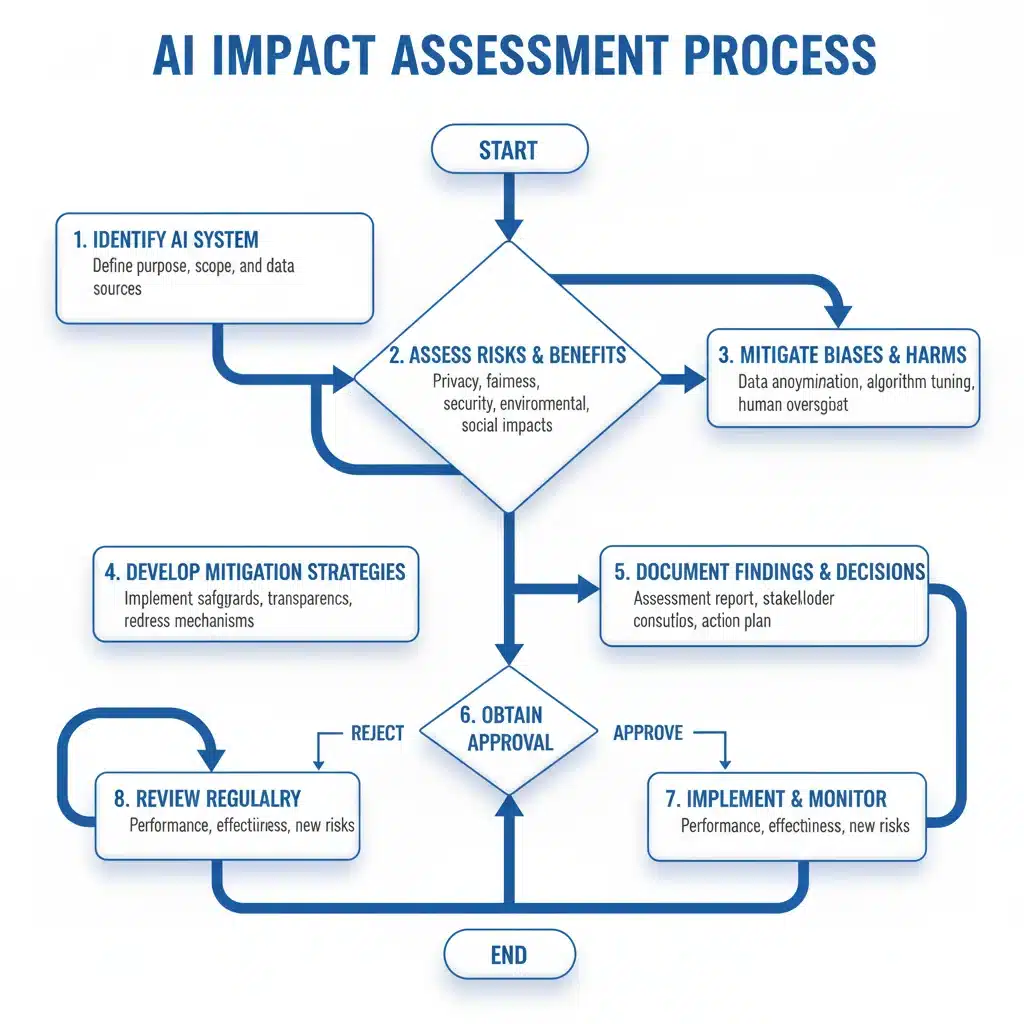
Critical Compliance Step 1: Conduct a Comprehensive AI Impact Assessment and Risk Audit
The foundational step for any organization aiming for US AI Regulations Compliance is to conduct a thorough AI impact assessment and a detailed risk audit of all existing and planned AI systems. This isn’t a one-time activity but an ongoing process that will help identify potential regulatory vulnerabilities, ethical concerns, and operational risks associated with your AI deployments.
What to Include in Your AI Impact Assessment:
- Inventory All AI Systems: Begin by creating a comprehensive inventory of all AI systems, algorithms, and machine learning models currently in use or under development within your organization. This includes third-party AI solutions you integrate. For each system, document its purpose, data sources, decision-making processes, and where it’s deployed.
- Identify High-Risk Applications: Categorize your AI systems based on their potential impact on individuals, society, and your business. High-risk applications typically involve critical decision-making (e.g., hiring, lending, healthcare diagnoses), public safety, or those that process sensitive personal data. These will likely face the most stringent regulatory scrutiny under U.S. AI Regulations Compliance.
- Assess Data Lineage and Governance: Trace the origin and flow of data used to train and operate your AI models. Ensure data is collected legally, stored securely, and processed ethically. Verify consent mechanisms are in place where required and that data quality is maintained to prevent bias.
- Evaluate for Bias and Fairness: Rigorously test your AI models for potential biases. This involves analyzing training data for representational imbalances and evaluating model outputs for discriminatory patterns across different demographic groups. Implement fairness metrics and continuous monitoring to detect and mitigate bias proactively.
- Analyze Transparency and Explainability: Determine the degree to which your AI systems’ decisions can be understood and explained. For high-risk applications, you’ll need mechanisms to provide clear, concise explanations to affected individuals. This might involve using explainable AI (XAI) techniques.
- Review for Security Vulnerabilities: Assess the cybersecurity posture of your AI systems. This includes protecting against data poisoning, adversarial attacks, model inversion, and ensuring the integrity of your AI infrastructure.
- Document Human Oversight Protocols: For each AI system, define the level of human oversight and intervention. Are there clear protocols for human review, override mechanisms, and grievance redressal processes?
- Identify Legal and Ethical Gaps: Compare your current AI practices against anticipated U.S. AI regulations, industry best practices, and your organization’s ethical guidelines. Pinpoint areas where your current approach falls short and requires remediation.
Benefits of a Proactive AI Impact Assessment:
- Early Risk Identification: Proactively uncover and address potential legal, ethical, and operational risks before they escalate.
- Informed Decision-Making: Gain a clear understanding of your AI portfolio, enabling strategic decisions about deployment, development, and resource allocation for US AI Regulations Compliance.
- Enhanced Trust: Demonstrating a commitment to responsible AI builds trust with customers, partners, and regulators.
- Reduced Compliance Costs: Addressing issues early is typically less expensive than reacting to regulatory penalties or lawsuits.
- Competitive Advantage: Organizations that can confidently demonstrate AI compliance will be favored by customers and partners in a regulated market.
This initial assessment forms the bedrock for your entire U.S. AI Regulations Compliance strategy. It provides the necessary data to prioritize efforts, allocate resources, and develop targeted remediation plans.
Critical Compliance Step 2: Establish Robust AI Governance Frameworks and Internal Policies
Once you have a clear understanding of your AI landscape and its associated risks, the next critical step is to establish robust AI governance frameworks and internal policies. This involves creating the organizational structure, processes, and documentation necessary to ensure ongoing adherence to US AI Regulations Compliance.
Key Components of an Effective AI Governance Framework:
- Define Roles and Responsibilities: Clearly delineate roles and responsibilities for AI governance across your organization. This might include:
- Chief AI Ethics Officer or AI Compliance Lead: Responsible for overseeing the entire AI compliance program.
- AI Review Board/Committee: A cross-functional team (legal, ethics, data science, engineering, business units) responsible for reviewing AI projects, assessing risks, and making compliance recommendations.
- Data Stewards: Responsible for data quality, privacy, and security for AI training and operation.
- AI Developers and Engineers: Accountable for implementing ethical design principles and technical safeguards.
- Business Unit Leaders: Responsible for ensuring AI applications within their domains comply with policies.
- Develop Comprehensive Internal AI Policies: Create a set of clear, actionable internal policies that guide the entire AI lifecycle, from conception to deployment and decommissioning. These policies should cover:
- Ethical AI Principles: Outline your organization’s commitment to fairness, transparency, accountability, privacy, and human oversight.
- Data Usage and Privacy: Specific guidelines for data collection, anonymization, storage, and processing for AI, aligning with all relevant privacy laws.
- Bias Detection and Mitigation: Protocols for testing, identifying, and addressing algorithmic bias in AI models.
- Transparency and Explainability Requirements: Standards for documenting AI system functionality and providing explanations for decisions.
- Human Oversight and Intervention: Guidelines for when and how humans should oversee and intervene in AI decision-making.
- AI Security Guidelines: Best practices for protecting AI systems from cyber threats.
- Vendor Management for AI: Policies for vetting and managing third-party AI providers to ensure their compliance aligns with yours.
- Implement an AI Risk Management Framework: Adopt a structured approach to identifying, assessing, mitigating, and monitoring AI-related risks. The NIST AI Risk Management Framework (AI RMF) provides an excellent starting point, offering a flexible, voluntary framework for managing risks associated with designing, developing, deploying, and using AI systems. This is central to effective U.S. AI Regulations Compliance.
- Establish Documentation and Record-Keeping Protocols: Maintain meticulous records of your AI systems, including design specifications, data sources, training methodologies, risk assessments, bias audits, and compliance reviews. This documentation will be crucial for demonstrating adherence to regulations.
- Develop Incident Response Plans for AI: Prepare for potential AI failures, biases, or security breaches. Establish clear procedures for identifying, responding to, and remediating AI-related incidents, including communication strategies for affected parties and regulators.
An effective AI governance framework ensures that US AI Regulations Compliance is not just a checkbox exercise but an embedded part of your organizational culture. It provides the necessary structure to manage the complexities of AI responsibly.

Critical Compliance Step 3: Invest in Continuous Monitoring, Training, and Auditing
Compliance with U.S. AI Regulations is not a static state; it’s an ongoing journey. The third critical step involves establishing mechanisms for continuous monitoring, comprehensive training, and regular auditing to ensure sustained adherence and adaptability to evolving regulations and technologies.
Components of Continuous Compliance:
- Implement Continuous Monitoring of AI Systems:
- Performance Monitoring: Track the accuracy, reliability, and effectiveness of your AI models in real-world environments.
- Drift Detection: Monitor for data drift (changes in input data characteristics) and model drift (changes in model performance over time) that could lead to biased outcomes or reduced accuracy.
- Bias Monitoring: Continuously assess AI outputs for discriminatory patterns and fairness metrics, triggering alerts if deviations occur.
- Security Monitoring: Implement tools to detect and respond to potential adversarial attacks or security vulnerabilities targeting your AI systems.
- Regulatory Updates: Keep abreast of new legislative developments, guidance, and enforcement actions related to US AI Regulations Compliance.
- Foster a Culture of AI Ethics and Compliance Through Training:
- Organization-Wide Awareness: Provide general training for all employees on the basics of responsible AI, data privacy, and the importance of compliance.
- Targeted Training for Developers and Data Scientists: Offer specialized training on ethical AI design principles, bias mitigation techniques, explainable AI methods, and secure AI development practices.
- Leadership Training: Equip business leaders with the knowledge to understand AI risks, make informed decisions, and champion responsible AI within the organization.
- Legal and Compliance Team Training: Ensure legal and compliance professionals are fully updated on the intricacies of U.S. AI Regulations and their implications.
- Conduct Regular Internal and External Audits:
- Internal Audits: Periodically review your AI systems, policies, and processes against your established governance framework and regulatory requirements. These audits should identify non-compliance, assess the effectiveness of controls, and recommend improvements.
- External Audits: Consider engaging independent third-party auditors to provide an objective assessment of your AI compliance posture. External audits can offer valuable insights, enhance credibility, and demonstrate due diligence to regulators and stakeholders. They are crucial for validating your US AI Regulations Compliance efforts.
- Audit Scope: Audits should cover data governance, model development, deployment, monitoring, risk management, and incident response.
- Iterative Improvement and Adaptation: The AI regulatory landscape is dynamic. Your compliance strategy must be agile and capable of iterative improvement. Use insights from monitoring and audits to refine policies, update technical safeguards, and adapt to new regulatory guidance.
By integrating continuous monitoring, comprehensive training, and regular auditing into your operational DNA, your organization can build a resilient and adaptable compliance program. This proactive approach not only mitigates risks but also positions your business as a leader in responsible AI innovation, a key differentiator in the evolving market.
Beyond Compliance: The Strategic Advantage of Responsible AI
While the immediate focus on U.S. AI Regulations Compliance is driven by the need to avoid penalties and legal challenges, business leaders should view this as an opportunity to gain a strategic advantage. Organizations that embed ethical and responsible AI practices into their core operations will reap significant long-term benefits.
Building Trust and Reputation:
In an era of increasing public scrutiny over AI, demonstrating a commitment to ethical and compliant AI builds invaluable trust with customers, employees, and partners. A strong reputation for responsible AI can differentiate your brand in a crowded market, attracting top talent and fostering customer loyalty. Consumers are becoming more aware of how their data is used and how AI impacts their lives, making ethical AI a significant factor in their purchasing decisions.
Fostering Innovation and Growth:
Paradoxically, robust AI governance can spur innovation rather than stifle it. By establishing clear guardrails and risk management processes, businesses can experiment with AI more confidently, knowing they have frameworks in place to manage potential pitfalls. This allows for more daring and impactful AI projects, accelerating growth while ensuring ethical boundaries are respected. Compliance with US AI Regulations Compliance provides a stable foundation for innovative ventures.
Mitigating Long-Term Risks:
Beyond immediate regulatory fines, irresponsible AI can lead to significant long-term risks, including costly lawsuits, severe reputational damage, and even operational shutdowns. A proactive compliance strategy minimizes these threats, safeguarding your organization’s future and ensuring sustainable AI adoption. The financial implications of legal battles and brand erosion can far outweigh the investment in compliance.
Attracting and Retaining Talent:
The best AI talent is increasingly drawn to organizations that prioritize ethical considerations and responsible development. By demonstrating a strong commitment to U.S. AI Regulations Compliance and ethical AI, you can attract and retain leading experts who want their work to have a positive societal impact. This can be a crucial competitive edge in the war for talent.
Enhancing Operational Efficiency:
Implementing strong AI governance often leads to better data management practices, improved model quality, and more streamlined development workflows. This can result in enhanced operational efficiency, reduced waste, and more reliable AI systems that deliver greater value to the business.
The Road Ahead: Preparing for 2026 and Beyond
The journey towards full U.S. AI Regulations Compliance is complex and ongoing. It requires a multidisciplinary effort involving legal, technical, ethical, and business stakeholders. As 2026 approaches, business leaders must prioritize these three critical steps:
- Conduct a Comprehensive AI Impact Assessment and Risk Audit: Understand your current AI landscape and identify all potential risks and compliance gaps. This diagnostic phase is non-negotiable.
- Establish Robust AI Governance Frameworks and Internal Policies: Build the organizational structure, define roles, and create clear guidelines that embed responsible AI practices throughout your business.
- Invest in Continuous Monitoring, Training, and Auditing: Ensure your compliance efforts are dynamic, adaptable, and continuously validated through ongoing surveillance, education, and independent review.
The regulatory environment for AI will undoubtedly continue to evolve beyond 2026. Organizations that embrace a proactive, adaptable, and ethically grounded approach to AI will be best equipped to navigate these changes, unlock the full potential of artificial intelligence, and maintain their competitive edge in the digital economy. The future belongs to those who deploy AI not just effectively, but responsibly.
Conclusion: A Call to Action for Business Leaders
The impending U.S. AI Regulations Compliance in 2026 represents a pivotal moment for businesses leveraging artificial intelligence. This is not merely a legal obligation but a strategic imperative that will define leaders from laggards in the coming years. By undertaking comprehensive AI impact assessments, establishing robust governance frameworks, and committing to continuous monitoring and training, organizations can transform potential compliance challenges into opportunities for growth, trust-building, and sustained innovation.
Business leaders must recognize that the ethical deployment of AI is no longer optional; it is a fundamental expectation from customers, regulators, and society at large. Proactive engagement with these regulations will not only mitigate risks but also foster a culture of responsibility that drives long-term value. The time to act decisively and strategically in preparing for US AI Regulations Compliance is now. Embrace this challenge, and position your organization at the forefront of the responsible AI revolution.