Boosting Sales with AI Tools: A 2026 Strategy to Increase Leads by 35%

In the rapidly evolving landscape of business, staying ahead means embracing innovation. For sales teams, this translates to leveraging cutting-edge technologies that can not only streamline processes but also predict future trends and personalize customer interactions at an unprecedented scale. The buzzword on every forward-thinking business leader’s lips is Artificial Intelligence (AI). By 2026, the integration of AI tools into sales strategies will not just be an advantage but a necessity for achieving significant growth, with a target of increasing leads by a remarkable 35%. This article delves into how your organization can harness the power of AI to achieve this ambitious goal, focusing on a comprehensive strategy for AI Sales Boost.
The traditional sales playbook is undergoing a dramatic transformation. What once relied heavily on intuition, cold calling, and generic outreach is now being augmented, and in many cases, revolutionized, by data-driven insights and automated intelligence. AI offers the capability to analyze vast amounts of data, identify patterns, predict customer behavior, and even generate personalized content, all at speeds and scales impossible for human teams alone. This isn’t about replacing human sales professionals; it’s about empowering them with a sophisticated toolkit that allows them to focus on high-value activities, build stronger relationships, and close more deals.
Our journey begins by understanding the foundational shifts AI brings to the sales paradigm, then moves into practical applications, strategic implementation, and finally, measuring the impact to ensure a sustained AI Sales Boost. Prepare to redefine your sales potential.
The AI Revolution in Sales: Why Now?
The adoption of AI in sales isn’t a futuristic concept; it’s a present-day imperative. Several factors are accelerating this integration:
- Explosion of Data: Every customer interaction, every website visit, every social media post generates data. AI tools are uniquely positioned to process and derive actionable insights from this deluge of information, turning raw data into strategic advantage.
- Advancements in Machine Learning: algorithms are becoming more sophisticated, capable of learning from complex patterns and making increasingly accurate predictions. This directly translates to better lead scoring, personalized recommendations, and optimized sales processes.
- Increased Competition: In a globalized and interconnected market, businesses are constantly vying for customer attention. AI provides a critical edge by enabling hyper-personalization and efficient resource allocation, allowing companies to stand out.
- Customer Expectations: Modern customers expect seamless, personalized, and relevant interactions. AI helps meet these expectations by understanding individual preferences and delivering tailored experiences at every touchpoint.
For organizations aiming for a 35% increase in leads by 2026, ignoring AI is no longer an option. It’s the engine that will drive efficiency, precision, and ultimately, unparalleled growth in sales.
Key Pillars of an AI-Driven Sales Strategy for 2026
To achieve a substantial AI Sales Boost, a multi-faceted approach is essential. This strategy hinges on several core pillars, each leveraging AI in distinct yet complementary ways.
1. AI-Powered Lead Generation and Prospecting
The first step in any sales process is identifying and qualifying potential customers. AI revolutionizes this by moving beyond traditional demographics to predictive analytics and behavioral insights.
- Predictive Lead Scoring: AI models analyze historical data, customer behavior, and firmographics to assign a score to each lead, indicating their likelihood of conversion. This allows sales teams to prioritize high-potential leads, significantly improving efficiency and conversion rates. Instead of chasing every lead, focus is placed on those most likely to become customers.
- Intelligent Prospecting: AI tools can scour the internet for new prospects that fit your ideal customer profile (ICP). They can identify companies showing buying signals, track industry trends, and even find key decision-makers within target organizations. This drastically reduces the time spent on manual prospecting and ensures a continuous flow of quality leads.
- Enriched Lead Data: AI can automatically enrich lead profiles with publicly available information, such as company size, technology stack, recent news, and social media activity. This provides sales reps with a comprehensive understanding of their prospects before the first interaction, enabling more personalized and effective outreach.
2. Personalization at Scale with AI
Generic marketing and sales messages are increasingly ineffective. AI enables hyper-personalization, making every interaction feel unique and relevant to the individual prospect.
- Dynamic Content Generation: AI can generate personalized email subject lines, body copy, ad creatives, and even website content based on a prospect’s demographic data, browsing history, and engagement patterns. This leads to higher open rates, click-through rates, and overall engagement.
- Personalized Product Recommendations: For e-commerce and B2C businesses, AI analyzes past purchases, browsing behavior, and similar customer profiles to recommend products or services that are most likely to appeal to an individual. This not only boosts sales but also enhances customer satisfaction.
- AI-Driven Outreach Sequencing: AI can recommend the optimal time, channel, and message for outreach to each prospect. It learns from past interactions to determine whether an email, a social media message, or a phone call would be most effective at a given stage of the sales cycle.
3. Optimizing the Sales Funnel with AI
AI can provide insights and automation at every stage of the sales funnel, from initial contact to closing the deal and beyond.
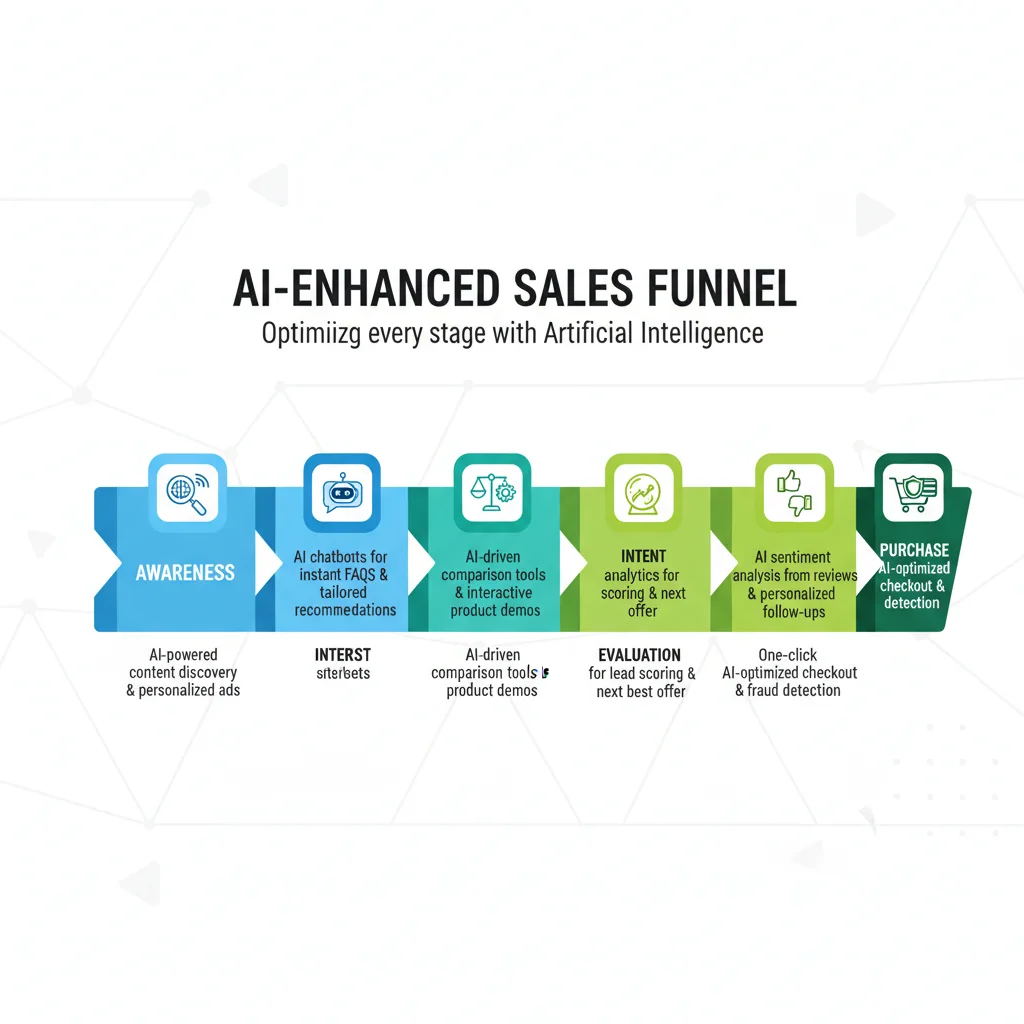
- Automated Follow-ups and Nurturing: AI-powered CRM systems can automate follow-up emails, schedule reminders for sales reps, and even trigger personalized content delivery based on prospect engagement. This ensures no lead falls through the cracks and keeps prospects engaged throughout their journey.
- Sales Assistant Chatbots: Chatbots can handle initial inquiries, answer frequently asked questions, qualify leads, and even book meetings for sales reps. This frees up human sales professionals to focus on more complex, high-value interactions.
- Deal Progression Analysis: AI can analyze the characteristics of successful and unsuccessful deals to identify patterns. It can then alert sales managers to deals that are at risk, suggest next best actions for improving deal velocity, and even predict the likelihood of closing. This proactive approach helps sales teams intervene effectively.
4. Enhancing Sales Enablement and Productivity
AI tools are not just for customer-facing activities; they also significantly boost the productivity and effectiveness of sales teams.
- Sales Coaching and Training: AI can analyze sales calls and presentations, providing real-time feedback on tone, sentiment, keywords used, and overall effectiveness. This offers invaluable insights for continuous improvement and personalized coaching for sales reps.
- Automated CRM Data Entry: A significant portion of a sales rep’s time is spent on administrative tasks. AI can automate data entry into CRM systems by transcribing calls, updating contact information, and logging activities, allowing reps to spend more time selling.
- Intelligent Content Recommendations: AI can recommend the most relevant sales collateral (case studies, whitepapers, presentations) to a sales rep based on the prospect’s industry, stage in the sales cycle, and specific pain points.
Implementing Your AI Sales Boost Strategy: A Roadmap to 2026
Achieving a 35% increase in leads by 2026 requires a structured and thoughtful implementation plan. Here’s a roadmap to guide your journey:
Phase 1: Assessment and Planning (6-12 Months)
- Define Clear Objectives: Beyond the 35% lead increase, what specific metrics will define success? (e.g., conversion rates, sales cycle length, average deal size).
- Audit Existing Sales Processes: Identify bottlenecks, inefficiencies, and areas where AI can have the most significant impact. Understand your current lead generation channels and their effectiveness.
- Data Readiness Assessment: Evaluate the quality, quantity, and accessibility of your sales and customer data. AI thrives on data, so ensuring clean, well-structured data is paramount.
- Team Training and Buy-in: Educate your sales team about the benefits of AI, address concerns, and involve them in the planning process. Successful adoption hinges on user acceptance.
- Technology Stack Evaluation: Research and select AI tools that integrate seamlessly with your existing CRM, marketing automation platforms, and other sales technologies. Consider scalability and future needs.
Phase 2: Pilot and Integration (12-18 Months)
- Start Small with a Pilot Project: Don’t try to implement everything at once. Choose one or two key areas (e.g., predictive lead scoring or AI-powered content personalization) for an initial pilot.
- Integrate Chosen AI Tools: Work with vendors and internal IT teams to integrate the selected AI solutions into your existing workflow. Ensure data flows smoothly between systems.
- Initial Training and Onboarding: Provide hands-on training for the pilot team. Gather feedback and make necessary adjustments to the tools and processes.
- Establish Baseline Metrics: Before full-scale deployment, clearly define and track your current performance metrics to accurately measure the impact of AI.
Phase 3: Scaling and Optimization (18-36 Months)
- Phased Rollout: Gradually expand the use of AI tools across more sales teams and different stages of the sales process.
- Continuous Monitoring and Analysis: Regularly track key performance indicators (KPIs) to assess the impact of AI on lead generation, conversion rates, and overall sales performance.
- Iterative Optimization: AI models require continuous feeding and refinement. Regularly review model performance, update data, and adjust algorithms to improve accuracy and effectiveness.
- Advanced AI Capabilities: As your team becomes proficient, explore more advanced AI applications, such as natural language processing (NLP) for sentiment analysis in customer communications or advanced forecasting models.
Measuring Success: KPIs for Your AI Sales Boost
To ensure your AI Sales Boost strategy is on track for a 35% lead increase by 2026, consistent measurement is crucial. Here are key performance indicators (KPIs) to monitor:
- Lead Volume: The most direct measure of your goal. Track the number of new leads generated monthly and compare it against your baseline.
- Lead Quality/Conversion Rate: Are the leads generated by AI converting at a higher rate? Monitor the percentage of leads that progress to qualified opportunities and closed deals.
- Sales Cycle Length: Does AI help shorten the time it takes to move a lead through the sales funnel to a closed deal?
- Average Deal Size: Are AI-driven insights helping sales reps identify opportunities for larger deals or upselling/cross-selling?
- Sales Productivity: Measure the time sales reps save on administrative tasks and prospecting, allowing them to focus on selling.
- Customer Lifetime Value (CLTV): While a longer-term metric, AI-driven personalization can lead to more satisfied customers and higher CLTV.
- Cost Per Lead (CPL): Is AI reducing the overall cost of acquiring a new lead?
Regularly review these KPIs and use the insights to refine your AI strategy. The beauty of AI is its ability to learn and adapt, so your strategy should too.

Challenges and Considerations
While the promise of an AI Sales Boost is compelling, it’s important to acknowledge potential challenges:
- Data Quality: ‘Garbage in, garbage out’ applies acutely to AI. Poor data quality will lead to inaccurate insights and ineffective AI applications. Invest in data cleansing and governance.
- Integration Complexities: Integrating new AI tools with existing systems can be complex. Plan meticulously and consider modular solutions.
- Talent Gap: Your team may need new skills to effectively manage and leverage AI tools. Invest in training or consider hiring data scientists and AI specialists.
- Ethical Considerations: Ensure your AI use is transparent, fair, and respects customer privacy. Adhere to data protection regulations like GDPR and CCPA.
- Over-Reliance on Automation: While AI automates, the human touch remains crucial in sales. Balance automation with personalized human interaction, especially for complex deals.
The Future of Sales: Human-AI Collaboration
The vision for 2026 isn’t one where AI replaces sales professionals. Instead, it’s a future of powerful human-AI collaboration. AI handles the heavy lifting of data analysis, lead qualification, and personalization, freeing up sales reps to do what they do best: build relationships, understand complex customer needs, negotiate deals, and provide strategic value.
Imagine a sales rep walking into a meeting armed with AI-generated insights about the prospect’s company financials, recent news, key decision-makers, and even their preferred communication style. This level of preparation, powered by AI, transforms a generic sales pitch into a highly relevant and persuasive conversation. This is the essence of an effective AI Sales Boost.
Organizations that embrace this symbiotic relationship will be the ones that not only achieve ambitious lead generation targets but also foster a more engaging, efficient, and ultimately more human sales experience for both their teams and their customers.
Conclusion: Seizing the AI Opportunity for Sales Growth
The journey to increasing leads by 35% by 2026 through an AI Sales Boost is ambitious but entirely achievable for businesses willing to invest in innovation. By strategically integrating AI into lead generation, personalization, sales funnel optimization, and sales enablement, companies can unlock unprecedented levels of efficiency and effectiveness.
This isn’t merely about adopting new technology; it’s about fundamentally rethinking your sales strategy. It’s about moving from reactive selling to proactive, data-driven engagement. It’s about empowering your sales team with the intelligence they need to succeed in an increasingly competitive market.
Start your AI transformation today. Assess your current state, plan your implementation meticulously, and commit to continuous optimization. The future of sales is intelligent, personalized, and highly efficient, and with the right AI strategy, your business can lead the way, achieving not just a 35% boost in leads but a complete revolution in your sales performance.
The time to act is now. The businesses that embrace AI today will be the market leaders of tomorrow. Don’t be left behind; harness the power of AI adoption to supercharge your sales and secure your competitive edge well into the future.