Generative AI in 2026: Revolutionizing Content & Cutting Costs for US Businesses

In the rapidly evolving landscape of technology, few innovations have captured the imagination and investment of businesses quite like Generative AI. As we look towards 2026, the promise of Generative AI 2026 is not merely speculative; it is a tangible force poised to redefine how US businesses operate, particularly in the realms of content creation and cost management. This isn’t just about automation; it’s about intelligent, creative automation that can drastically enhance efficiency and reduce expenditures.
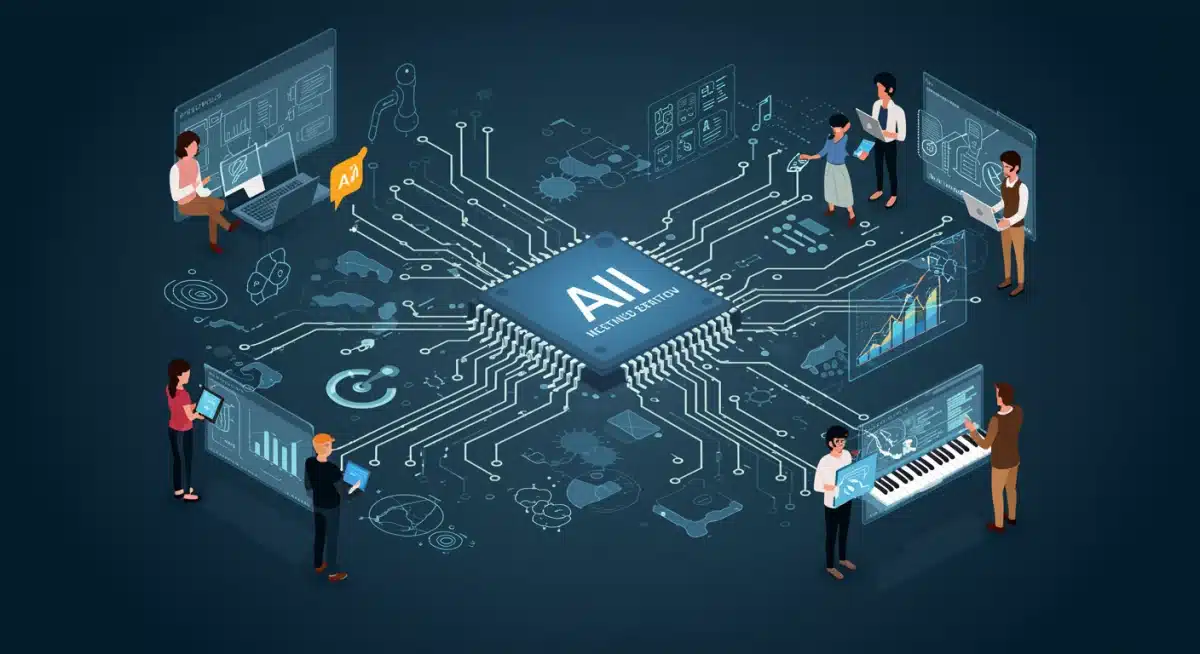
The advent of Generative AI marks a pivotal moment, ushering in an era where machines don’t just process information but create it. From crafting compelling marketing copy and designing innovative product prototypes to generating lifelike images and even composing music, the capabilities of Generative AI are vast and growing. For US businesses, this technology presents an unprecedented opportunity to gain a competitive edge, streamline operations, and, crucially, achieve significant financial savings.
Our focus in this comprehensive exploration is to unpack the profound impact of Generative AI 2026, specifically how it is projected to revolutionize content creation and lead to a remarkable 10% reduction in production costs for businesses across the United States. We will delve into the underlying mechanisms, the diverse applications, and the strategic implications for various industries, providing a roadmap for businesses to harness this transformative power.
The Dawn of Creative Machines: Understanding Generative AI
Before we project into the future, it’s essential to grasp what Generative AI truly entails. Unlike traditional AI, which often focuses on analysis, classification, or prediction, Generative AI models are designed to produce novel outputs. These models, powered by advanced machine learning techniques, particularly deep learning and neural networks, learn patterns and structures from vast datasets and then use this understanding to generate new, original content that mirrors the characteristics of the training data.
Key Technologies Driving Generative AI
- Generative Adversarial Networks (GANs): These consist of two neural networks, a generator and a discriminator, locked in a perpetual game. The generator creates data, and the discriminator tries to distinguish it from real data. This adversarial process refines the generator’s ability to produce highly realistic outputs.
- Variational Autoencoders (VAEs): VAEs learn a compressed representation of input data and then use this representation to generate new, similar data. They are particularly adept at creating variations of existing content.
- Transformer Models: Revolutionizing natural language processing, transformer models like GPT-3 and its successors are exceptionally good at understanding context and generating coherent, human-like text, translating languages, and summarizing information.
- Diffusion Models: These models work by progressively adding noise to data and then learning to reverse that process to generate new, high-quality data. They have shown remarkable success in generating realistic images and audio.
These technological advancements are not just academic curiosities; they are the engines driving the practical applications of Generative AI 2026 that we are beginning to see emerge across industries. The ability of these models to learn complex relationships and create sophisticated outputs is what makes them so revolutionary for content creation.
Revolutionizing Content Creation: A New Paradigm by 2026
The impact of Generative AI 2026 on content creation is perhaps its most visible and immediate benefit. Businesses of all sizes are grappling with the ever-increasing demand for fresh, engaging, and personalized content across multiple platforms. Manual content creation is often time-consuming, resource-intensive, and can struggle to scale effectively. Generative AI offers a powerful solution.
Accelerated Content Production
One of the most significant advantages is the sheer speed at which Generative AI can produce content. Imagine a marketing department needing hundreds of unique ad variations for A/B testing, or a news organization needing to summarize complex reports into digestible articles quickly. Generative AI can accomplish these tasks in a fraction of the time it would take human creators.
- Marketing Copy: AI can generate countless headlines, product descriptions, email subject lines, and social media posts, optimized for engagement and conversion.
- Image and Video Generation: From stock photos to bespoke illustrations, and even short video clips, AI can create visual content tailored to specific needs, dramatically reducing reliance on expensive stock libraries or custom design work.
- Personalized Content at Scale: Businesses can leverage AI to create highly personalized content for individual customers, enhancing engagement and improving customer experience, something that is virtually impossible to do manually on a large scale.
- Code Generation: For software development, AI can assist in writing code, debugging, and even generating entire software components, speeding up development cycles.
Enhanced Creativity and Ideation
While often associated with automation, Generative AI also acts as a powerful creative partner. It can provide novel ideas, explore unconventional design solutions, and generate variations that human creators might not have considered. This isn’t about replacing human creativity but augmenting it, allowing creative professionals to focus on higher-level strategic thinking and refinement.
For example, a graphic designer can use AI to generate dozens of logo concepts in minutes, then refine the most promising ones. A writer can use AI to overcome writer’s block, generating different narrative arcs or descriptive passages. This collaborative model between human and AI is where the true power of Generative AI 2026 lies in fostering innovation.
The Financial Impact: A 10% Reduction in Production Costs for US Businesses
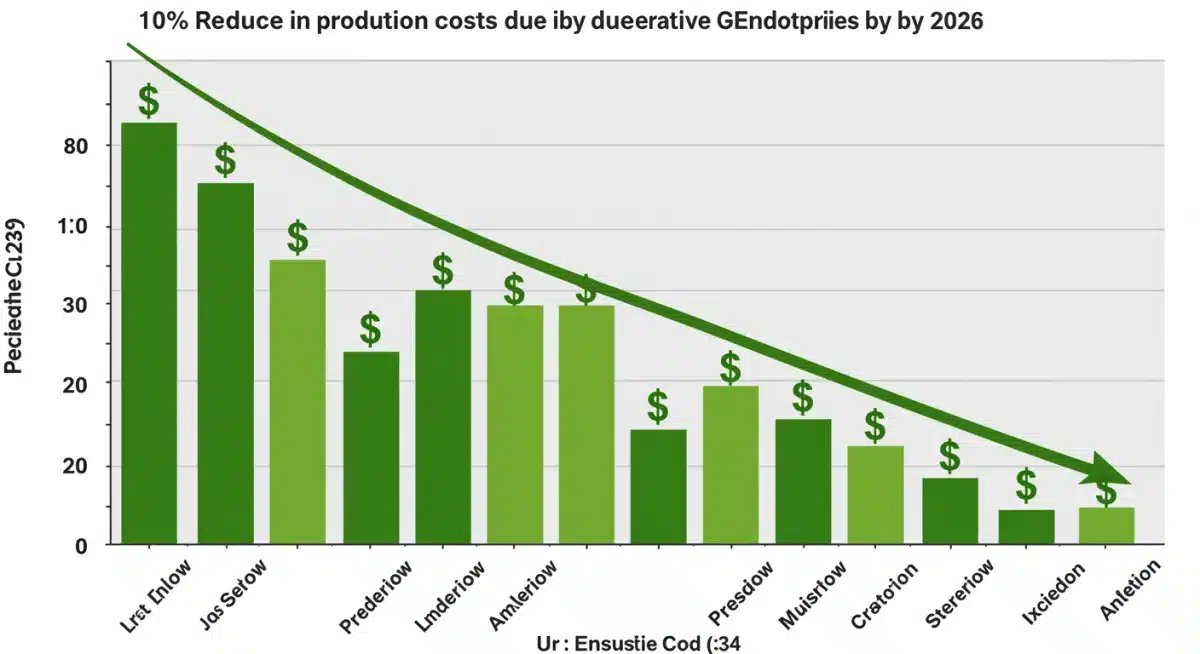
The most compelling argument for the widespread adoption of Generative AI 2026 for many US businesses will undoubtedly be its financial benefits. Our projection of a 10% reduction in production costs by 2026 is not an arbitrary figure; it’s based on the cumulative effect of efficiencies gained across various business functions where content creation and related tasks are prevalent.
Reduced Labor Costs
By automating repetitive and time-consuming content tasks, businesses can significantly reduce the need for extensive human labor in these areas. This doesn’t necessarily mean job displacement across the board, but rather a reallocation of human talent to more strategic and oversight roles. For instance, a single content strategist, augmented by AI, can manage the output of what previously required a team of junior writers or designers.
- Marketing Departments: Less time spent on drafting initial copy, designing basic visuals, or managing content calendars.
- Customer Service: AI-generated responses for FAQs and even personalized customer communications can reduce the load on human agents.
- Product Development: AI can generate design iterations and simulations, reducing the need for extensive manual prototyping and testing.
Lowering Content Acquisition and Licensing Fees
Many businesses spend significant amounts on licensing stock photos, videos, and music. With Generative AI, they can create unique, custom assets on demand, eliminating or substantially reducing these recurring costs. This not only saves money but also ensures brand consistency and originality.
Optimized Resource Allocation
The ability of Generative AI to quickly produce and iterate on content means that businesses can test different strategies more rapidly and with fewer resources. This agile approach leads to more effective campaigns and product development, reducing the waste associated with ineffective initiatives. By understanding what resonates with audiences faster, businesses can allocate their marketing and R&D budgets more efficiently.
Scalability Without Proportional Cost Increase
One of the traditional challenges of scaling content production is that costs often increase proportionally with output. Generative AI fundamentally changes this dynamic. Once an AI model is trained and integrated, it can generate vast quantities of content with minimal additional cost per unit. This allows businesses to expand their reach and engage more customers without a linear increase in expenditure, a critical factor for achieving a 10% cost reduction by Generative AI 2026.
Industry-Specific Applications and Cost Savings
The financial benefits of Generative AI 2026 will not be uniformly distributed but will manifest uniquely across various sectors. Each industry has specific content needs and cost structures that Generative AI can address.
E-commerce and Retail
In e-commerce, the need for compelling product descriptions, engaging ad copy, and personalized marketing materials is relentless. Generative AI can:
- Automatically generate unique product descriptions from specifications, reducing the need for copywriters.
- Create personalized email campaigns and social media ads tailored to individual customer preferences, boosting conversion rates and reducing customer acquisition costs.
- Generate virtual try-on experiences or product visualizations, reducing the need for expensive photoshoots.
These applications directly contribute to lower marketing expenses and improved sales efficiency, driving towards that 10% cost reduction benchmark.
Media and Entertainment
The media industry thrives on content. Generative AI offers transformative potential:
- Assisting scriptwriters in generating dialogue or plot ideas.
- Creating background music or sound effects for films and games.
- Generating synthetic media for visual effects, reducing complex and costly CGI processes.
- Personalizing news feeds and content recommendations at an unprecedented scale.
The ability to rapidly prototype and produce elements of creative works translates directly into significant cost savings in production budgets.
Healthcare and Pharmaceuticals
While not immediately obvious, Generative AI has crucial applications in healthcare, particularly in research and patient communication:
- Generating synthetic patient data for research and training, protecting privacy while providing vast datasets.
- Assisting in drafting research papers and summarizing complex medical literature.
- Creating personalized patient education materials in various languages and formats.
Streamlining communication and research processes can lead to substantial operational efficiencies and cost reductions in administrative and R&D overhead.
Manufacturing and Design
For industries focused on physical products, Generative AI is a game-changer in design:
- Generative Design: AI algorithms can explore thousands of design variations for products or components, optimizing for factors like strength, weight, or material usage. This can drastically reduce design cycle times and material costs.
- Prototyping: Virtual prototypes generated by AI can minimize the need for physical prototypes, saving significant time and resources.
- Marketing Materials: As with retail, AI can create high-quality visualizations and marketing copy for new products.
The optimization potential here is immense, directly impacting material costs, labor for design, and time-to-market.
Challenges and Considerations for Widespread Adoption
While the promise of Generative AI 2026 is compelling, its widespread adoption and the realization of a 10% cost reduction are not without challenges. Businesses must navigate these hurdles strategically.
Data Quality and Bias
Generative AI models are only as good as the data they are trained on. Biased or low-quality data can lead to outputs that are inaccurate, inappropriate, or perpetuate harmful stereotypes. Businesses must invest in clean, diverse, and representative datasets to ensure ethical and effective AI deployments.
Integration and Infrastructure
Integrating Generative AI tools into existing workflows and IT infrastructure can be complex. It requires technical expertise, robust cloud computing resources, and careful planning to ensure seamless operation and data security. The initial investment in these areas can be substantial, though the long-term returns justify it.
Ethical and Legal Implications
The ability of AI to create realistic content raises significant ethical questions regarding intellectual property, deepfakes, misinformation, and accountability. Businesses must establish clear guidelines and ethical frameworks for AI use, ensuring transparency and responsible deployment. The legal landscape surrounding AI-generated content is also still developing, requiring careful monitoring.
Talent Gap and Reskilling
While AI automates tasks, it also creates a demand for new skills – AI trainers, prompt engineers, ethical AI specialists, and professionals who can effectively collaborate with AI tools. Businesses need to invest in reskilling their workforce to leverage Generative AI effectively, transforming roles rather than simply eliminating them.
Cost of Advanced Models
While Generative AI promises cost reduction, the use of highly advanced, proprietary models can come with significant licensing fees or computational costs. Businesses need to carefully evaluate the ROI and choose solutions that align with their budget and specific needs.
Strategies for US Businesses to Leverage Generative AI by 2026
To fully capitalize on the potential of Generative AI 2026 and achieve the projected cost savings, US businesses should consider the following strategies:
Start Small and Scale Up
Instead of a full-scale overhaul, businesses should identify specific, high-impact areas where Generative AI can be piloted. This could be automating social media post generation, creating internal reports, or assisting with basic design tasks. Learning from these smaller deployments allows for iterative improvement and a more confident scale-up.
Invest in Data Governance and Quality
Prioritize building and maintaining high-quality, unbiased datasets. Implement strong data governance practices to ensure the integrity and ethical use of data that feeds Generative AI models. This foundation is critical for reliable and effective outputs.
Foster a Culture of AI Literacy and Collaboration
Educate employees across departments about the capabilities and limitations of Generative AI. Encourage experimentation and collaboration between human experts and AI tools. The most successful implementations will involve humans guiding and refining AI outputs, rather than AI working in isolation.
Choose the Right Tools and Partners
The Generative AI landscape is rapidly expanding with numerous tools and platforms. Businesses should carefully evaluate solutions based on their specific needs, scalability, integration capabilities, and vendor support. Partnering with experienced AI consultants or solution providers can accelerate adoption and minimize risks.
Establish Ethical AI Guidelines
Develop clear internal policies and ethical guidelines for the use of Generative AI. Address concerns around intellectual property, bias, transparency, and accountability. This proactive approach builds trust and mitigates potential legal and reputational risks.
Continuously Monitor and Adapt
The field of Generative AI is dynamic. Businesses must stay abreast of new advancements, regularly evaluate the performance of their AI systems, and be prepared to adapt their strategies as the technology evolves. Continuous learning and optimization are key to sustaining the benefits of Generative AI 2026.
The Future is Now: Embracing Generative AI for Competitive Advantage
The year 2026 is not far off, and the groundwork for the widespread impact of Generative AI is already being laid. For US businesses, this isn’t an optional upgrade but a strategic imperative. The ability to create high-quality, personalized content at scale, while simultaneously reducing production costs by a significant margin, offers an undeniable competitive advantage.
Those who embrace Generative AI 2026 thoughtfully and strategically will be the ones who lead their respective industries. They will innovate faster, engage customers more effectively, and operate with greater efficiency. The 10% cost reduction is more than just a number; it represents increased profitability, greater investment capacity for R&D, and the flexibility to navigate future market shifts.
The journey towards full Generative AI integration will involve learning curves, ethical considerations, and strategic investments. However, the destination – a future where creativity is augmented, efficiency is maximized, and costs are optimized – makes this journey well worth undertaking. Businesses that fail to adapt risk being left behind in an increasingly AI-driven economy.
In conclusion, Generative AI 2026 is set to be a transformative force, reshaping the very fabric of content creation and financial management for US businesses. By understanding its potential, addressing its challenges, and adopting a forward-thinking strategy, businesses can not only achieve a 10% reduction in production costs but also unlock new avenues for innovation and growth in the years to come.