AI Bias Auditing: 90% Fairness Compliance by 2026 in the US

An AI bias auditing strategy is no longer optional but a critical imperative for organizations aiming for 90% fairness compliance by 2026 in the US. This insider’s guide delves into the methodologies, regulatory nuances, and practical steps needed to navigate the complex landscape of ethical AI development.
Understanding the AI Bias Landscape in 2026
By 2026, the landscape of artificial intelligence is marked by increasingly sophisticated algorithms and a heightened public and regulatory demand for ethical AI. Understanding the various forms of AI bias is the foundational step towards effective auditing. These biases can manifest in data collection, model design, or even during deployment, leading to discriminatory outcomes that erode trust and carry significant legal and reputational risks.
The urgency stems from the rapid adoption of AI across critical sectors like healthcare, finance, and criminal justice, where biased decisions can have profound societal impacts. Organizations must move beyond mere compliance checklists and embed fairness into the very fabric of their AI development lifecycle. This involves a shift in mindset, prioritizing ethical considerations alongside performance metrics.
Types of AI Bias and Their Impact
AI bias can take many forms, each with unique origins and implications. Recognizing these distinctions is crucial for targeted auditing. For example, historical bias arises from societal prejudices reflected in training data, while measurement bias can occur due to inconsistencies in data collection or labeling processes.
- Algorithmic bias: Inherent flaws in the algorithm’s design or training that lead to unfair outcomes.
- Data bias: Skewed or unrepresentative datasets that teach the AI system to make biased decisions.
- Cognitive bias: Human biases influencing data labeling or model interpretation, perpetuating existing prejudices.
- Systemic bias: Bias embedded within the broader operational context where AI is deployed, affecting its real-world impact.
The impact of unchecked AI bias can range from financial losses due to inaccurate predictions to severe reputational damage and legal sanctions. More importantly, it can exacerbate existing social inequalities, reinforcing discriminatory practices against protected groups. This makes a proactive and comprehensive approach to AI bias auditing indispensable for any responsible organization.
Establishing a Robust AI Fairness Framework
To systematically address AI bias, organizations need a well-defined AI fairness framework. This framework serves as a blueprint, guiding the entire process from initial data acquisition to continuous model monitoring. It ensures that fairness is not an afterthought but an integral part of every stage of AI development and deployment. A robust framework outlines clear objectives, defines fairness metrics, and establishes governance structures.
Developing such a framework requires cross-functional collaboration, involving data scientists, ethicists, legal experts, and business stakeholders. It’s about translating abstract ethical principles into quantifiable metrics and actionable strategies. Without a clear framework, efforts to achieve fairness compliance can become disjointed and ineffective, leading to inconsistent results and missed opportunities for improvement.
Key Components of an Effective Framework
An effective AI fairness framework typically includes several core components. These elements work in concert to create a comprehensive system for mitigating bias and promoting ethical AI. Each component plays a vital role in ensuring that fairness considerations are systematically integrated into the AI lifecycle.
- Fairness definitions: Clearly define what ‘fairness’ means in the context of specific AI applications and target populations.
- Metrics and measurement: Establish quantitative metrics (e.g., demographic parity, equalized odds) to measure bias and track progress.
- Governance and policies: Implement internal policies, roles, and responsibilities for ethical AI development and oversight.
- Documentation and transparency: Maintain thorough documentation of AI models, data sources, and bias mitigation efforts.
Beyond these components, a truly robust framework emphasizes continuous learning and adaptation. As AI technologies evolve and societal expectations shift, the framework must be flexible enough to incorporate new insights and best practices. This iterative approach ensures that the organization remains at the forefront of ethical AI development, consistently striving for higher fairness compliance.
Regulatory Landscape and Compliance by 2026
The regulatory landscape surrounding AI bias is rapidly evolving, particularly in the US, with 2026 projected to see more stringent enforcement and clearer guidelines. Organizations must stay abreast of these changes to ensure compliance and avoid potential penalties. Key regulations and proposed frameworks from federal agencies like the National Institute of Standards and Technology (NIST) and state-level initiatives are shaping the expectations for AI fairness.
Understanding these regulations is not just about avoiding fines; it’s about building trust with consumers and stakeholders. Non-compliance can lead to significant legal challenges, reputational damage, and a loss of market share. Proactive engagement with these emerging standards positions organizations as leaders in responsible AI development, fostering innovation within ethical boundaries.
Navigating Emerging US Regulations
Several key regulatory developments are influencing AI bias auditing in the US. The NIST AI Risk Management Framework (AI RMF), while voluntary, is quickly becoming a de facto standard for best practices in managing AI risks, including bias. Furthermore, sector-specific regulations, such as those from the Equal Employment Opportunity Commission (EEOC) regarding AI in hiring, are becoming more prescriptive.
- NIST AI RMF: Provides guidelines for managing risks associated with AI, including bias detection and mitigation.
- State-level laws: Laws like New York City’s Local Law 144 on automated employment decision tools are creating mandatory compliance requirements.
- Federal guidance: Agencies are increasingly issuing guidance on the responsible use of AI, signaling future legislative intent.
- Industry standards: Growing pressure from industry consortia and self-regulatory bodies to adopt ethical AI practices.
By 2026, we anticipate a more harmonized yet comprehensive regulatory environment. Organizations that invest now in robust AI bias auditing practices will be better prepared to meet these evolving requirements, leveraging compliance as a competitive advantage rather than a burden. This forward-looking approach is crucial for long-term success in the AI-driven economy.
Practical Tools and Methodologies for Auditing
Effective AI bias auditing relies on a combination of practical tools and methodologies designed to detect, measure, and mitigate bias. These tools range from open-source libraries to commercial platforms, each offering different capabilities for analyzing various aspects of fairness. Choosing the right tools depends on the specific AI application, the type of data, and the nature of potential biases.
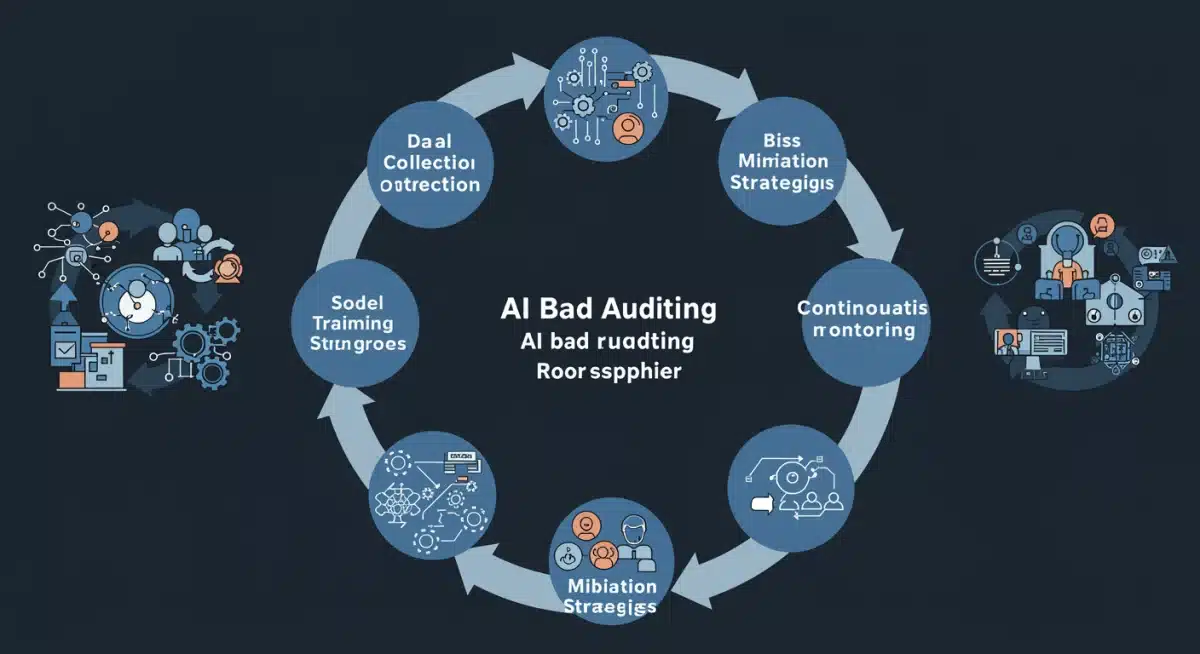
Beyond tools, robust methodologies are essential for systematically applying these instruments. This includes defining clear auditing workflows, establishing baseline fairness metrics, and developing repeatable processes for bias detection. The goal is to move from ad-hoc checks to a structured, continuous auditing pipeline that integrates seamlessly into the AI development lifecycle.
Leveraging AI Bias Detection Tools
Numerous tools are available to assist in AI bias detection. Open-source libraries like IBM’s AI Fairness 360 (AIF360), Google’s What-If Tool, and Microsoft’s Fairlearn provide powerful functionalities for identifying different types of bias and evaluating fairness metrics. These platforms often offer visualizations and explanations that help data scientists understand the sources and impacts of bias.
- AI Fairness 360 (AIF360): A comprehensive open-source toolkit with metrics and algorithms for detecting and mitigating bias.
- What-If Tool: An interactive tool for exploring model behavior, understanding performance across different data subsets, and identifying potential biases.
- Fairlearn: A Microsoft-developed open-source toolkit that helps developers assess and improve the fairness of AI systems.
- Commercial solutions: Proprietary platforms offering advanced features, scalability, and integration with enterprise systems.
The effective use of these tools requires expertise in data science, machine learning, and ethical AI principles. It’s not enough to simply run a tool; auditors must interpret the results, understand their implications, and formulate appropriate mitigation strategies. This blend of technical proficiency and ethical reasoning is at the heart of successful AI bias auditing.
Mitigation Strategies and Continuous Monitoring
Detecting bias is only half the battle; the next crucial step is implementing effective mitigation strategies and establishing continuous monitoring systems. Mitigation techniques aim to reduce or eliminate identified biases, while continuous monitoring ensures that fairness is maintained over time as models are deployed and interact with real-world data. These two components are vital for achieving and sustaining high levels of fairness compliance.
The selection of mitigation strategies depends on the type and source of bias. Some strategies focus on preprocessing data to remove bias, others modify the model training process, and some intervene post-processing to adjust model outputs. Regardless of the approach, thorough testing and validation are essential to ensure that mitigation efforts do not introduce new biases or degrade model performance in unintended ways.
Implementing Effective Bias Mitigation
Bias mitigation can be applied at various stages of the AI pipeline. Pre-processing techniques involve modifying the training data to be more representative or balanced. In-processing methods integrate fairness constraints directly into the model’s learning algorithm. Post-processing techniques adjust the model’s predictions to achieve desired fairness outcomes.
- Data re-sampling: Adjusting the proportions of different groups in the training data to ensure adequate representation.
- Adversarial debiasing: Training a model to be fair by using an adversary that tries to predict sensitive attributes from the model’s output.
- Fairness-aware regularization: Adding terms to the model’s loss function to penalize unfair outcomes during training.
- Threshold adjustment: Modifying decision thresholds for different groups to achieve equitable outcomes.
Continuous monitoring is equally critical. AI models are dynamic systems that can drift over time, with new biases emerging as they interact with evolving data. Implementing automated monitoring systems that regularly check for fairness violations and trigger alerts is essential. This proactive approach allows organizations to identify and address issues before they lead to significant harm, ensuring long-term fairness compliance.
Building an Ethical AI Culture Within Organizations
Achieving 90% fairness compliance by 2026 goes beyond technical solutions; it necessitates fostering a robust ethical AI culture within the organization. This involves cultivating a shared understanding of ethical principles, promoting responsible practices, and embedding accountability at every level. An ethical culture ensures that fairness considerations are ingrained in decision-making processes, from leadership to individual developers.
This cultural shift requires strong leadership commitment, clear communication, and ongoing education. It’s about creating an environment where employees feel empowered to raise ethical concerns and where ethical considerations are valued alongside business objectives. Without a strong ethical foundation, even the most sophisticated tools and frameworks may fall short in preventing and mitigating AI bias.
Key Pillars of an Ethical AI Culture
Several pillars underpin a thriving ethical AI culture. Transparency and accountability are paramount, ensuring that AI systems are understandable and that individuals are responsible for their ethical implications. Education and training equip employees with the knowledge and skills to identify and address bias. Diverse teams bring varied perspectives, helping to uncover potential biases that might otherwise be overlooked.
- Leadership commitment: Senior management actively champions ethical AI and allocates resources for its implementation.
- Employee training: Regular workshops and courses on AI ethics, bias detection, and responsible development practices.
- Diverse teams: Promoting diversity in AI development teams to bring varied perspectives and reduce blind spots.
- Ethical review processes: Establishing formal mechanisms for reviewing AI projects for ethical implications and bias risks.
Ultimately, building an ethical AI culture is a continuous journey, not a destination. It involves ongoing reflection, adaptation, and a commitment to learning from both successes and failures. By prioritizing ethical AI, organizations can not only achieve compliance but also build greater trust with their users and contribute to a more equitable and responsible technological future.
| Key Aspect | Brief Description |
|---|---|
| Bias Identification | Recognizing various forms of bias in data, algorithms, and deployment to prevent discriminatory outcomes. |
| Fairness Framework | Establishing a structured approach with defined metrics and governance for ethical AI development. |
| Regulatory Compliance | Navigating evolving US regulations and standards like NIST AI RMF to ensure legal and ethical adherence. |
| Mitigation & Monitoring | Implementing strategies to reduce bias and continuously tracking AI systems for fairness over time. |
Frequently Asked Questions About AI Bias Auditing
By 2026, US organizations face increasing regulatory scrutiny and public demand for ethical AI. Auditing helps prevent discriminatory outcomes, mitigate legal and reputational risks, and build trust. It ensures compliance with emerging standards like the NIST AI RMF and sector-specific regulations, which are becoming more stringent.
Key types include algorithmic bias (flaws in design), data bias (skewed datasets), and systemic bias (embedded in operational context). Understanding these distinctions is vital for targeted auditing and developing effective mitigation strategies. Each type requires a specific approach to detection and resolution.
An effective framework defines fairness metrics, establishes governance, and ensures documentation. It requires cross-functional collaboration, translating ethical principles into actionable strategies, and continuous adaptation. This structured approach integrates fairness into every stage of the AI development lifecycle, ensuring consistent ethical standards.
Open-source tools like IBM’s AI Fairness 360, Google’s What-If Tool, and Microsoft’s Fairlearn are widely used. These platforms offer functionalities for identifying various biases and evaluating fairness metrics. Commercial solutions also provide advanced features, scalability, and integration capabilities for enterprise-level deployment.
An ethical AI culture fosters a shared understanding of principles, promotes responsible practices, and embeds accountability. It ensures that ethical considerations are valued alongside business objectives, leading to more sustainable and trustworthy AI systems. Leadership commitment and continuous training are crucial for this cultural shift.
Conclusion
Achieving 90% fairness compliance in AI systems by 2026 in the US is an ambitious yet attainable goal for organizations committed to ethical AI. This requires a multi-faceted approach, encompassing a deep understanding of bias types, the establishment of robust fairness frameworks, diligent navigation of the evolving regulatory landscape, and the strategic deployment of practical auditing tools. Crucially, it also demands a fundamental shift towards an ethical AI culture, where fairness is not merely a technical checkbox but a core organizational value. By integrating these elements, businesses can build AI systems that are not only powerful and innovative but also equitable and trustworthy, securing their place as leaders in the responsible AI era.